How a 60-day payment cycle costs your agency more than just cash flow
The average agency waits 58 days to be paid after submitting an invoice. Most operations leads know the number. What most don't calculate is what that 58-day wait costs beyond the cash itself.
Here is the part nobody adds to the estimate. Your account manager spends 84 minutes this month following up on three overdue invoices. Your finance lead runs a payment report on Friday before sending another reminder on Monday. Your CEO holds off on approving a new hire because two retainer payments are still outstanding at day 45. None of that time appears in any invoice. None of it reduces the amount you're owed. It is pure overhead generated by the payment cycle, and it compounds every month.
Industry data from the 2025 Ignition Agency Pricing and Cash Flow Report puts a number on this: 97% of agencies are actively chasing at least one overdue invoice at any given time. 84% spend three to ten hours every month just on collections follow-up. For an eight-person agency where a senior team member owns that work, that is between $300 and $1,000 in billed-equivalent time spent recovering money the agency already earned.
The three costs that don't appear on your receivables report
You can pull an aged receivables report and see the dollar amount outstanding. What you can't see in that report are the three real costs your agency absorbs while you wait.
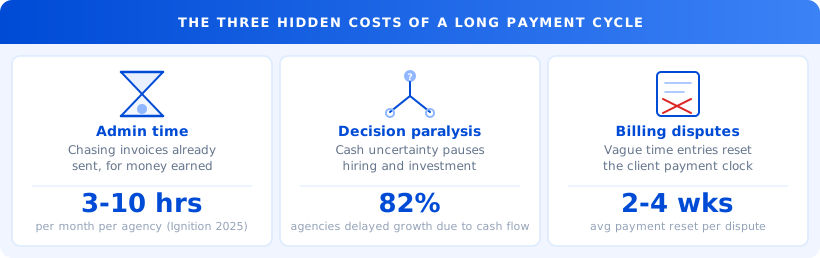
Admin time. Someone on your team spends time chasing invoices that have already been sent. Reminder emails, follow-up calls, re-sending PDFs, "just checking in" messages. The Ignition data puts this at 3 to 10 hours per month for most agencies. At $100 per hour in billing equivalent, that is $300 to $1,000 in overhead every single month, on work that generates zero revenue.
Decision paralysis. When you don't know whether an overdue invoice will arrive this week or next month, you make conservative decisions. Hiring gets delayed. Software renewals get deferred. Contractor rates get squeezed. The uncertainty tax is real: 82% of agencies in the Ignition study delayed or cancelled investment in growth because cash flow was unpredictable. You're not making bad decisions. You're making decisions with bad information.
Billing disputes that slow payment. The most common reason clients push back on invoices is that the hours don't match what they remember. A vague timesheet line, a missing project description, or an unexpected task with no context resets the payment clock by two to four weeks. Billing accuracy and payment speed are not separate problems. They are the same problem, separated by 30 days.
Important
If your agency sends invoices with time entries logged from memory at end of week, expect at least one payment dispute every two to three months. The cost is not just the delay. It is the conversation you have to have with a client who already feels they're paying a lot.
Why agencies accept long payment cycles without questioning them
Payment cycles stretch because everyone in the chain treats length as normal.
Your client's AP team runs payments on a monthly cycle. Their manager approves invoices in bulk on the last Friday of the month. Their finance policy says Net 45. You've worked with this client for two years and the relationship is strong, so pushing hard feels like a risk.
That tolerance compounds over time. Net 30 becomes Net 45 becomes 60 days in practice. You start building the 60-day cycle into your cash flow projections as a fixed assumption. It stops looking like a problem and starts looking like the cost of doing business with good clients.
"We had four retainer clients paying on a 45 to 60-day cycle and considered that normal. When we finally ran the numbers on what our collection admin was costing us, it was the equivalent of half a junior hire each year. Just in chasing money we'd already earned."
The normalization is the problem. Payment cycles do not shorten on their own. They shorten when agencies give clients a reason to pay faster and make it easy for them to do so.
The link between billing accuracy and payment speed
Here is the part most agencies miss: the length of your payment cycle is partly a documentation problem.
When a client receives an invoice with clear time logs attached, accurate project descriptions, and a breakdown that matches the scope they approved, they have no reason to question it. The AP process takes two business days. Payment follows the agreed terms.
When a client receives a lump-sum line ("50 hours, June project"), their first instinct is to verify. That verification triggers a conversation. The conversation takes a week. Payment follows three weeks after that.
The gap between a clean invoice and a disputed one is rarely about the hours. It is about documentation. A time entry logged the same day the work happened contains more detail, survives client scrutiny, and moves through AP without a detour.
Trakkar's time tracking keeps a running record of work as it happens, so that when invoice time comes, your line items have descriptions that match what the client remembers. The invoice management feature uses those logs to build invoices that are itemized, client-readable, and traceable to specific project work. Less "how did you get to this number?" and more "approved, forwarding to AP."
Reports and analytics surface your invoice aging so you can see which clients are consistently slow, how often they raise disputes, and what the effective payment lag is by account. That visibility turns a vague cash flow anxiety into a specific account management question.
What one agency found when they tightened the loop
A creative agency running six retainer clients averaged roughly 60 days to collect payment after invoicing. They had tried a few things: adding payment terms to email footers, switching to PDF invoices with embedded payment links. None of it moved the number.
The real problem was earlier in the process. Their time logs were submitted weekly, in bulk, by team members reconstructing the week from memory. By the time those logs became invoice line items, the descriptions were generic. "Content work, 12 hours." "Campaign planning, 8 hours." Clients approved those in the moment and questioned them three weeks later when invoices arrived.
When they switched to daily time logging with project-specific descriptions, three things changed. Invoice disputes dropped from roughly one per billing cycle to one in six months. The monthly overhead of chasing invoices dropped from about 10 hours to under 2. And the payment cycle on their top three accounts dropped from 58 days to 34.
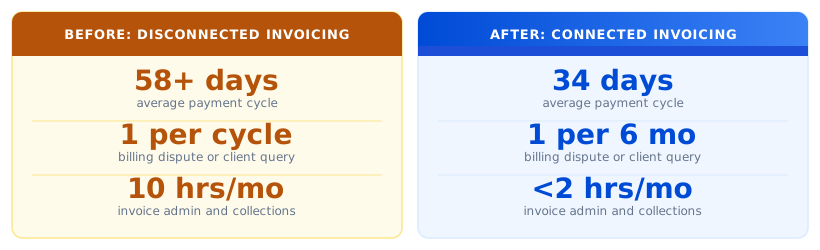
Not because the clients suddenly got faster. Because the invoice no longer gave them a reason to pause.
What to do this week
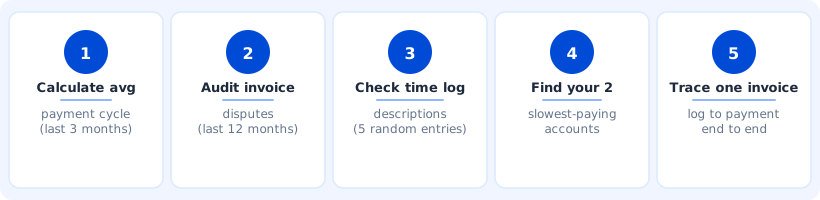
You don't need to renegotiate payment terms or send a firm email to a valued client. Five steps, five days.
Day 1: Calculate your current average payment cycle. Pull your last three months of invoices. For each one, record the date sent and the date payment cleared. Average the days. If that number is above 40, you have room to recover real cash flow without a single awkward client conversation.
Day 2: Run an invoice dispute audit. For the last 12 months, count how many invoices triggered a client question or request to verify before payment. Note the common reasons. Vague descriptions and hours that don't match estimates are the two most frequent causes.
Day 3: Check the quality of your time log descriptions. Pull five random time entries from last month. Could a client read those entries and understand exactly what was done, without asking a follow-up question? If the answer is no for more than two of them, your billing documentation is creating payment lag.
Day 4: Identify your two slowest-paying accounts. For these clients, the 58-day average is probably 75 or 80 days. Decide whether the issue is their AP process, your invoice clarity, or the relationship dynamic. Each one has a different fix, and all three are addressable.
Day 5: Trace one full invoice from log to payment. Pick one invoice from last month and walk the complete timeline: when was the time logged, when was the invoice built, when was it sent, when was it chased, when was it paid. That single walkthrough will show you exactly where your cycle is longest.
Tip
Start with one client account, not your whole portfolio. A single account review takes 30 minutes and tells you whether your problem is documentation, process, or relationship. Trying to audit everything at once usually means none of it gets done.
One concrete next step
Your agency has already earned the money sitting in overdue invoices. The question is whether the gap between "earned" and "paid" is costing more than you've calculated.
If you run a client-facing agency and you have never connected your time logs to invoice quality and payment cycle in one view, you're managing a cash flow problem with incomplete information.
See how Trakkar handles invoicing for agencies, or book a 20-minute demo and we'll walk through your last billing cycle and show you exactly where the payment gap is coming from.