Most agencies don't know they have a leakage problem until someone audits an invoice.
You billed 40 hours on the Acme retainer this month. The client pushes back. Your designer insists she worked closer to 55. Your project lead thinks it was 48. Nobody can prove any of it, because half the hours were logged two days after the fact, from memory, in a spreadsheet that three people share but nobody trusts.
This is not a discipline problem. It is a system problem. And it costs the average 10-person agency between $8,000 and $15,000 a month in unrecorded revenue.
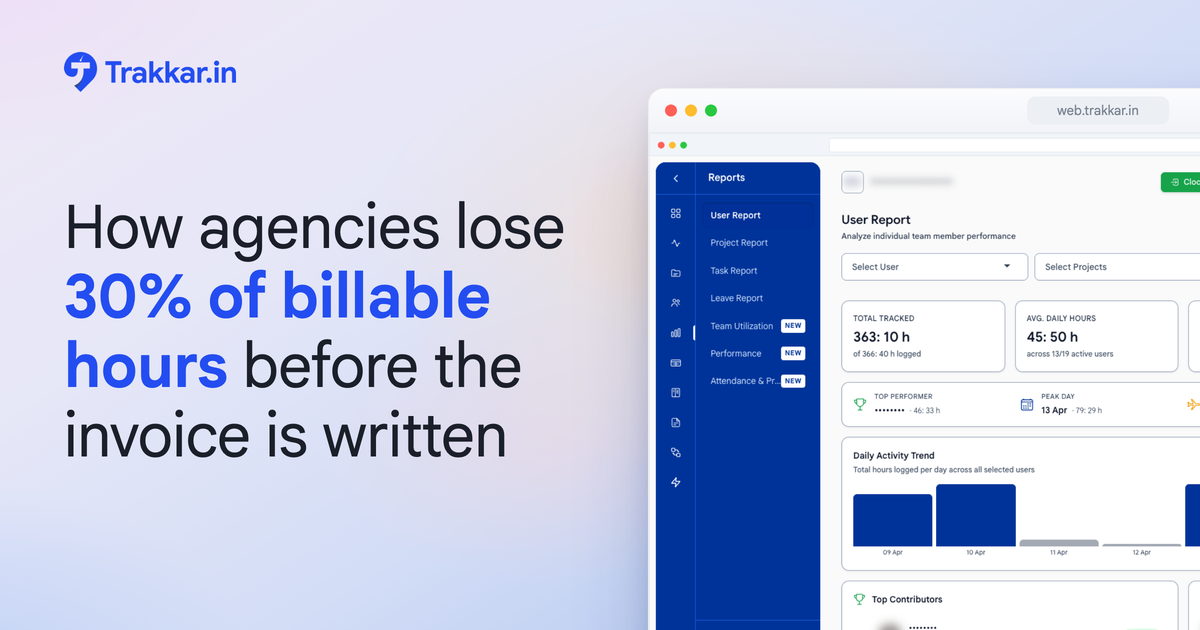
Industry data from billing software providers consistently shows agencies capture only 62–70% of the hours their team actually works. The rest evaporates before anyone writes an invoice. For a team billing $100,000 a month, that is $30,000 to $38,000 in work delivered and never charged.
Where the hours actually go
The lost hours do not disappear all at once. They leak in four specific places.
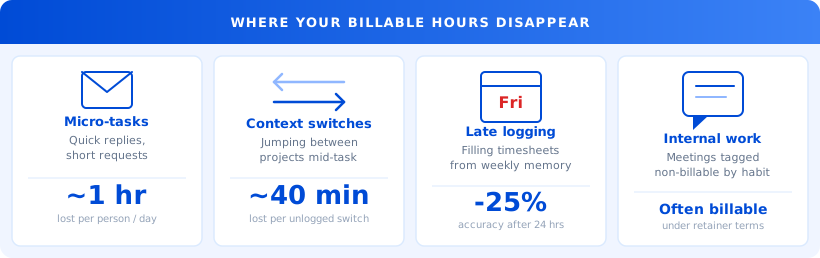
Micro-tasks nobody logs. A client emails at 9am with a "quick question." Your account manager spends 14 minutes drafting a careful reply. Nobody creates a timer for 14 minutes. Do that twice a day across a five-person client-facing team and you lose an hour of billable time before lunch, every single day.
Context switches with no clock reset. Your developer is mid-sprint on Project A when Slack pulls her into an urgent bug on Project B. She fixes it in 40 minutes and jumps back. No timer was stopped. No new one was started. The 40 minutes of Project B work gets billed to nothing.
End-of-week retrospective logging. Friday afternoon, your team fills in their timesheets for the week. Human recall of non-linear tasks degrades fast. Most people underestimate time spent on tasks by 20–30% when they log more than 24 hours after doing the work. Log on Monday for last Thursday, and the number is basically a guess.
"Internal" work that clients would pay for. Status meetings, revision calls, async Loom walkthroughs. These often get categorized as non-billable admin out of habit, not because the client contract actually excludes them. Many retainers cover exactly this kind of coordination work.
If your team logs time weekly rather than daily, expect 20–30% of your hours to be underreported before you've even looked at scope creep or unbillable tasks.
The math on your specific team
Run this once. You will not forget it.
Take your team's average billable rate. Multiply it by 30 minutes per person per day, a conservative estimate of unlogged time based on industry research. Multiply by your team size. Multiply by 22 working days.
For a 10-person team billing at an average of $80 per hour:
0.5 hrs x 10 people x $80 x 22 days = $8,800 per month.
That is $105,600 per year. A senior hire, fully loaded, walking out the door because your time-tracking system relies on good intentions and short-term memory.
Bump the team to 20 people and you're at $211,200 annually. At $100 per hour average rate, $264,000. The number scales faster than most ops leads expect.
Run this calculation for your own team right now: (daily unlogged minutes / 60) x team size x hourly rate x 22. Most ops leads who do this for the first time are surprised by how fast it compounds.
Why chasing every minute is not the answer
The wrong fix is to mandate that everyone log time in real-time, down to the minute, with a manager reviewing every entry.
That creates resentment. Your best people start updating timesheets to tell managers what they want to hear rather than what actually happened. You trade accurate data for compliant-looking data. The numbers look cleaner. The leakage stays the same.
The right fix is a system where capturing time is easier than skipping it, and where weekly reports make the gaps visible before they turn into invoice disputes.
There is a meaningful difference between accountability and surveillance. Accountability gives your team a running record they can reference. Surveillance watches for violations. The first improves invoicing accuracy. The second degrades morale.
What a real capture system looks like
Agencies that close this gap do three things differently from the ones that don't.
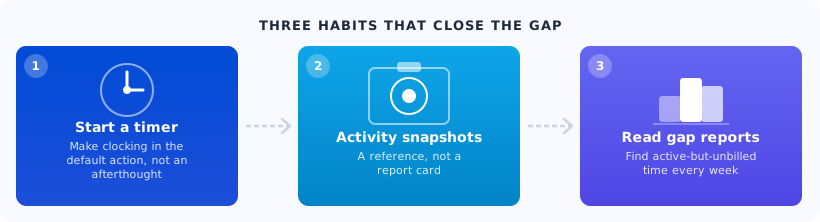
They make starting a timer the default behavior. When work begins, a timer starts. Not because someone is watching, but because the system makes it easier to clock in than to skip it. A persistent timer display means forgetting to log is harder than remembering.
They use periodic activity snapshots as a reference, not a report card. A screenshot every 10 to 20 minutes is not about watching your team work. It gives the team a reference point when writing descriptions. "What was I working on at 2:15pm Tuesday?" is a hard question without a visual anchor. With one, it takes three seconds to answer. The result is more accurate descriptions and fewer retroactive guesses.
They read gap reports, not just timesheets. A timesheet tells you what was logged. A gap report shows you where a person was active but no project time was recorded. That gap is where the money is hiding. Run it weekly. Use it to have a specific conversation instead of a vague one.
Trakkar's time tracking keeps a persistent clock running across projects so that context switches get captured rather than lost. The screenshot manager builds a lightweight activity trail your team can actually use to fill in accurate descriptions. And reports and analytics surfaces utilization gaps by person and project, so you have a real number to point to instead of a suspicion.
The whole setup is designed for the kind of agency that doesn't want to install surveillance software but also doesn't want to lose $100,000 a year to unrecorded work.
What a real agency found in 90 days
A digital agency running 12 active retainers noticed their average billable utilization was sitting at 61%. Eight people, an average billing rate of $95 per hour, and a rough estimate of about $7,000 per month in unrecorded time.
"We weren't losing work to scope creep. We were delivering the scope and then forgetting to bill for half of it."
They made two changes. First, they moved from weekly timesheet submission to daily logging with a hard close at 6pm. Second, they turned on 15-minute screenshot intervals and started using the activity feed during weekly retainer reviews.
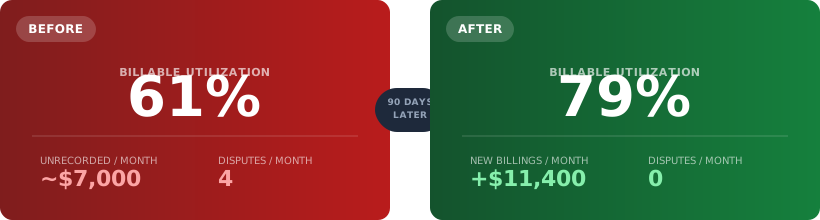
The hours were always there. They just weren't being captured before they were invoiced.
What to do this week
You don't need a new process or a three-month rollout. Here is what you can do in the next five working days.
Day 1: Run a utilization check. Pull last month's logged hours by person. Divide by the scheduled hours for that person. Anyone below 70% is your starting point. That gap is recoverable without adding a single client.
Day 2: Add a 15-minute minimum log rule. Any task over 15 minutes gets a timer entry before the person moves on. No retrospective logging for work that happened more than 24 hours ago.
Day 3: Set up a gap report for next Friday. Flag any day where a team member was clocked in but recorded zero project time. That gap is your most immediate recovery target.
Day 4: Audit your "internal" categories. Review which meetings, calls, and async reviews are currently tagged non-billable. Ask whether your retainer agreements actually exclude them or whether that's just a habit nobody has questioned.
Day 5: Run a real-time audit on one project. Compare what was invoiced last month to what was actually worked, using your time logs. The delta will surprise you. Use it as the baseline for the next billing cycle.
Start with one project, not your whole portfolio. A single project audit takes 30 minutes and gives you a concrete number to bring to the next team meeting. Doing all projects at once takes a week and usually doesn't happen.
One concrete next step
If you want to see your specific leakage number before committing to anything, Trakkar can show you a gap report for your team in a 20-minute demo. You'll see exactly where the unlogged time is coming from and what it's worth at your billing rate.
See how Trakkar works for agencies, or book a 20-minute demo and we'll walk through your team's billable-hour leakage in the first ten minutes.