Your team logged 600 hours last month. Utilization sits at 75%. The dashboard looks healthy. Then the finance call happens and the collected revenue is 28% lower than the number you quoted your clients.
This is not a discipline problem or a pricing problem. It is a measurement problem. Utilization tells you how busy your team is. It tells you almost nothing about how much of that busyness turns into money in your account.
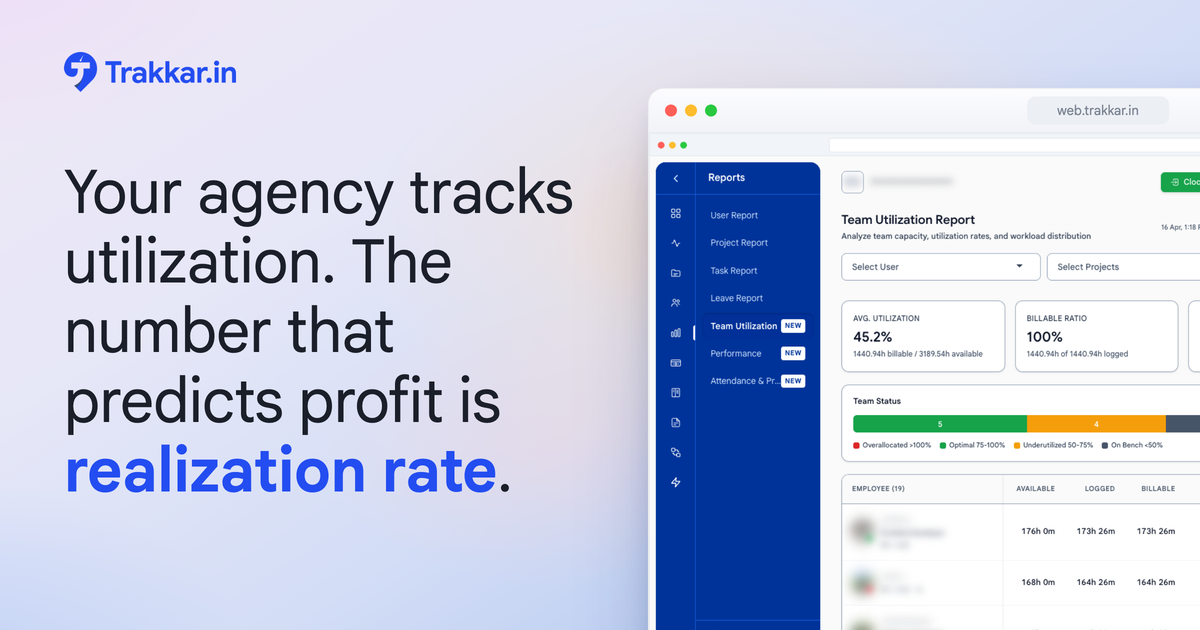
The metric you are missing is realization rate. Industry benchmarks for 2026 put the average agency realization rate between 72% and 78%. If you are not tracking it separately from utilization, you are probably sitting somewhere in that range without knowing it, which means your 75%-utilization agency is monetizing roughly 52–57% of its available capacity.
For a 10-person team billing at $90 per hour, that gap costs between $18,000 and $25,000 per month in work delivered and not collected.
What utilization actually measures
Utilization rate is straightforward: hours logged on billable work divided by total available hours. If your team has 800 available hours in a month and logs 600 on client projects, utilization is 75%.
That number is useful. It tells you whether your team is fully scheduled. It helps you decide whether to hire or whether you have headroom to take on a new account.
What it does not tell you is how many of those 600 logged hours actually made it onto an invoice. Or how many invoiced hours the client paid in full, without a dispute or a retroactive discount.
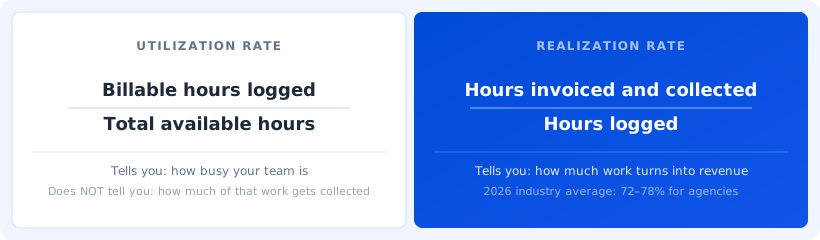
Most agency ops leads see 75% and assume they are capturing 75% of revenue potential. They are capturing 75% of logged hours. That is a different number entirely.
What realization rate actually measures
Realization rate is the percentage of logged hours that end up invoiced and collected at full rate, without a write-down.
The formula: (hours invoiced and paid at full rate) divided by (hours logged), multiplied by 100.
At a 70% realization rate, for every 100 hours your team logs, 30 hours of work gets written off, discounted after the fact, disputed by the client, or billed to a project with no remaining budget.
Stack that on top of a 75% utilization rate:
- 1,000 available hours x 75% utilization = 750 logged billable hours
- 750 hours x 70% realization = 525 hours actually collected at full rate
- That is 52.5% of your team's capacity being monetized
The other 47.5% is either idle time or work you did and did not get paid for. For most agencies, the idle time slice is small. The uncompensated work slice is where the revenue is hiding.
Where realization erodes
The gap between logged hours and collected revenue does not appear in one place. It accumulates quietly across four.
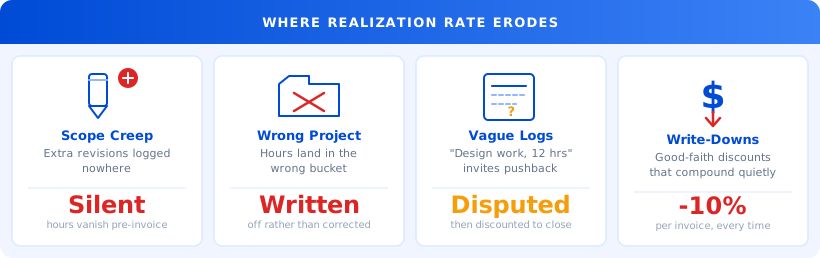
Scope creep with no paper trail. A client asks for "just one more round" of revisions. The designer does it. Nobody logs the additional time because it feels like a grey area or a goodwill gesture. The hours evaporate before the invoice is written. Multiply this by five clients and twelve months and the number becomes significant.
Hours logged to the wrong project. A developer spends three hours fixing a bug on Client A's platform but logs it under a general support bucket or, worse, under Client B's project by mistake. At billing time, Client A's invoice is short and nobody knows why. The hours get written off rather than corrected, because reconstructing a three-week-old log entry takes more time than anyone is willing to spend.
Vague time descriptions that invite client pushback. An invoice line that says "design work, 12 hours" gives the client nothing to anchor to. They push back. You discount to smooth things over. You have just written down two hours of real work because your time log could not defend it. Clients are not always acting in bad faith here. They genuinely cannot see what 12 hours of "design work" produced.
Retroactive discounts that compound. Every time you knock 10% off an invoice to protect a client relationship, you are doing two things: training the client to expect a discount and signaling to your own team that precision in logging does not matter. Over 12 months, those write-downs on a 10-person team add up to a number that most agency founders find uncomfortable to look at.
The math on a real agency
Take an 8-person agency. Average billable rate of $90 per hour. Full schedule at 75% utilization.
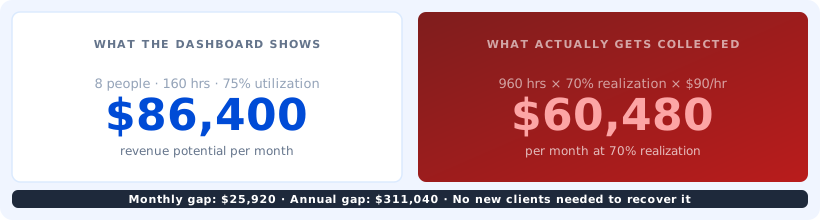
What the utilization dashboard shows: 8 people x 160 hours x 75% = 960 billable hours x $90 = $86,400 in revenue potential per month.
What actually gets collected at 70% realization: 960 hours x 70% = 672 collected hours x $90 = $60,480 per month.
The gap is $25,920 per month. That is $311,040 per year.
"We thought our utilization problem was a sales problem. We kept trying to fill more capacity. What we actually had was a realization problem. We were filling the capacity and then bleeding the revenue out the other side before the invoice went out."
Closing that gap from 70% to 80% realization on the same team, with no new clients and no rate increase, would recover $86,400 annually. That is a meaningful number for an eight-person agency. It does not require a single new client conversation.
How to close the gap without adding overhead
The instinct is to add more tracking, more approval steps, more invoice review layers. That creates friction that your best people will work around.
The real fix is making every logged hour defensible at the moment it is logged, not at invoice time. There are three things that move the needle.
Log with task-level descriptions in real time. A timer entry that says "Homepage hero redesign, second iteration incorporating stakeholder feedback from 3 May call" is billable without a conversation. "Design work" is not. Writing that description takes 10 seconds while the context is fresh. Reconstructing it on Friday takes 10 minutes and a Slack thread and still produces a guess.
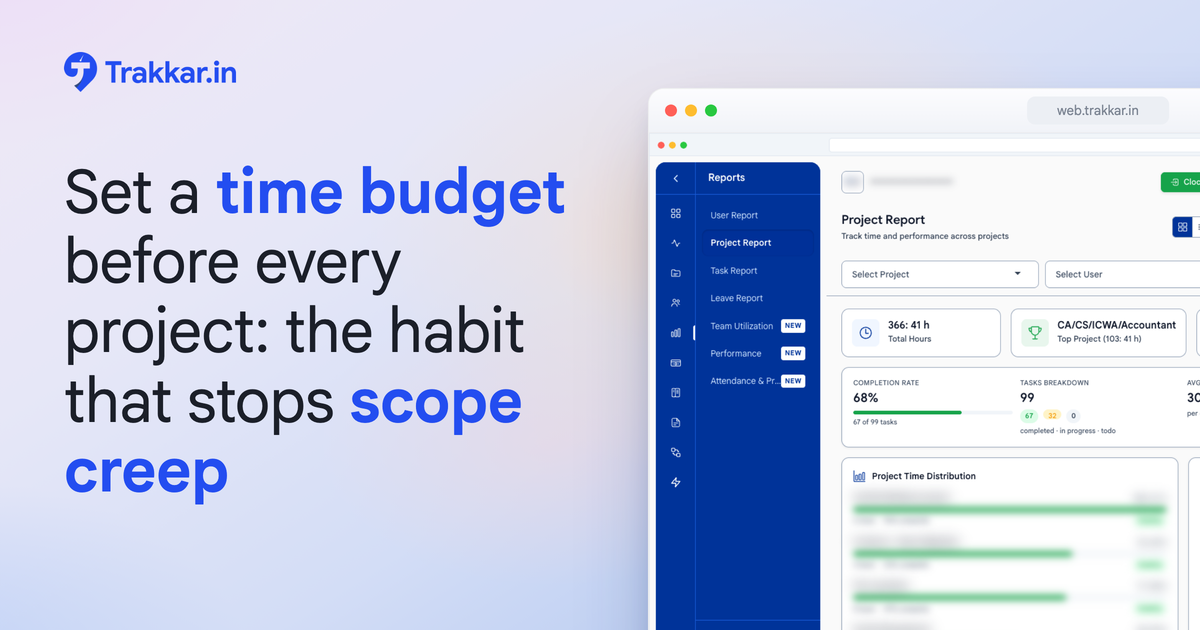
Match logged hours to project budgets before the invoice is written. If your project had a 40-hour budget and 52 hours were logged, you need to know that before the invoice goes out, not after the client sees it. A weekly report that surfaces budget-versus-logged by project gives you a window to have a scope conversation proactively instead of reactively. Proactive conversations result in approved change orders. Reactive ones result in write-downs.
Use activity records as a billing defense, not a performance review. When a client disputes "8 hours of development work," an activity record showing what was on the developer's screen during those hours is not surveillance. It is invoice defense. Most clients drop the dispute when you can show them the work. Trakkar's screenshot manager builds that record automatically, in the background, without any logging burden on the team member.
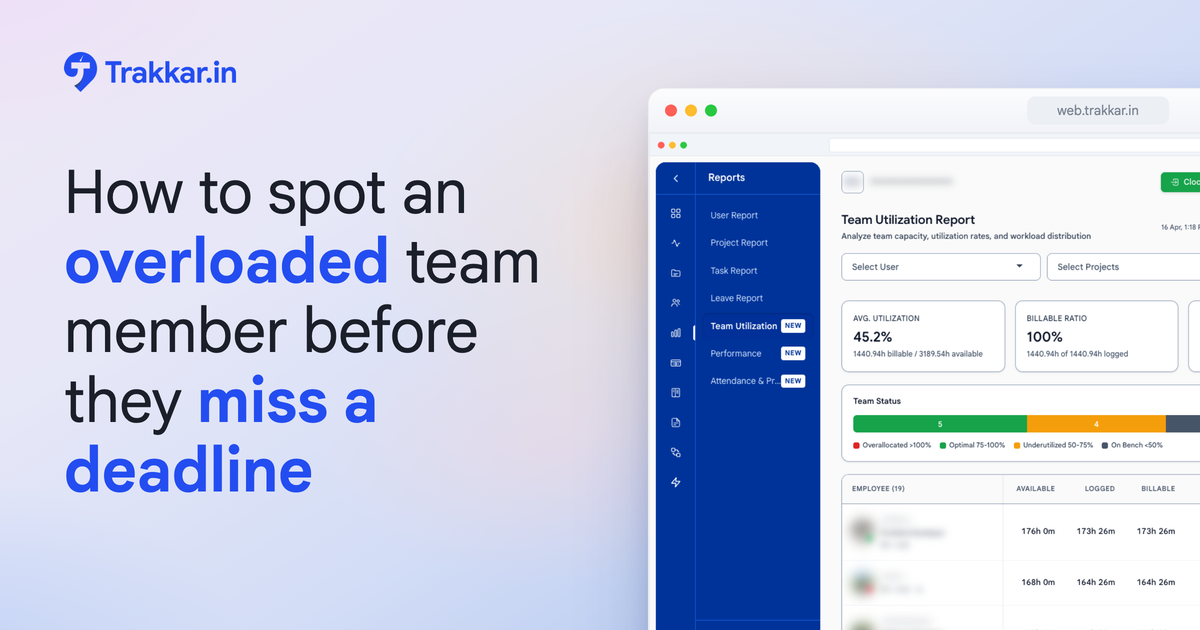
Trakkar's time tracking keeps timers project-specific and makes logging a description the path of least resistance rather than an afterthought. Paired with reports and analytics, you can run a realization check every Friday before invoices go out rather than discovering the gap when a client pushes back.
The agency-specific setup is built for teams where every logged hour needs to survive a client question.
What to do this week
You do not need a process overhaul to start recovering realization. Here is a five-day sequence that works without disrupting how your team operates.
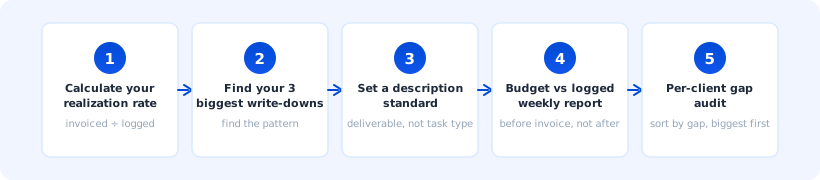
Day 1: Calculate your current realization rate. Pull last month's total logged billable hours. Pull total invoiced hours. Divide invoiced by logged. If you cannot break these out separately right now, that gap in your reporting is itself the first problem to fix.
Day 2: Find your three biggest write-downs. Look at last month's invoices and find the three projects where you billed fewer hours than were logged. Write down why in one line each. Scope creep, client dispute, or wrong project logged? You will see a pattern quickly.
Day 3: Set a description standard. One rule: every time entry must name the specific deliverable worked on. Not "design." Not "development." "Homepage hero, mobile breakpoint revisions, v3." Run it for one week before mandating anything. The before-and-after on invoice disputes usually sells the team on it faster than any policy memo.
Day 4: Set up a budget-versus-logged report. Pull a comparison of budgeted hours versus logged hours for each active project. Run it every Friday before your team signs off for the week. Any project running over budget by more than 10% gets a conversation before the invoice, not after. This one change, consistently applied, is where most agencies recover the largest chunk of their realization gap.
Day 5: Run the realization math per client. Compare logged hours to invoiced hours for your top five clients. Sort by gap. The client with the widest gap is where you are losing the most money and getting no credit for the work. That is your first scope conversation.
The agencies that start tracking realization alongside utilization consistently report 8 to 12 percentage point improvements within 90 days. That is not from working more. It is from getting paid for the hours already worked.
One concrete next step
If you want to see your agency's actual realization rate before committing to any process changes, Trakkar can walk you through it in under 20 minutes.
See how Trakkar works for agencies, or book a 20-minute demo and we will show you exactly where your realization gap is sitting and what it is worth at your billing rate.