Your last project finished on time. The client was happy. You invoiced for 40 hours.
Then someone pulled the actual time logs. 54 hours worked. 14 never billed.
Those 14 hours were not dramatic scope creep. Nobody asked for a new feature. Nobody moved the deadline. But someone spent 3 hours on a revision round that was not in the original brief. Someone else handled two unplanned client calls. The onboarding document got rewritten because the requirements shifted mid-sprint. Small things. Each one under an hour. None of them on the invoice.
A 2025 report by Ignition surveyed agencies across the US and UK and found that 57% lose between $1,000 and $5,000 every month to unbilled scope creep. Another 30% lose more than $5,000 a month. And only 1% of agencies successfully bill for all the out-of-scope work their teams deliver.
One percent.
Why scope creep is invisible until it is too late
The problem is not that clients are unreasonable. The problem is that most scope changes happen one small task at a time, and no individual task feels worth stopping to document.
A client sends a Slack message at 2pm: "Can you make that button a different color?" Your designer opens the file, makes the change, exports a new version. 25 minutes. She does not create a timer entry. It does not feel like a project task. It feels like being helpful.
Later that day, the project manager gets a question about the timeline. He spends 35 minutes pulling together a status update in a more readable format. He does not log it. It was just an email.
By end of week, the project has absorbed 3 hours of work that nobody tracked. Across six active projects, that is 18 hours of unlogged billable time in a single week. At $90 per hour, that is $1,620 gone before anyone has written a single invoice.
The issue is not that these tasks are unbillable. Many retainer and project agreements cover exactly this kind of coordination work. The issue is that nobody is tracking them as project work in the first place.
The four places scope quietly expands
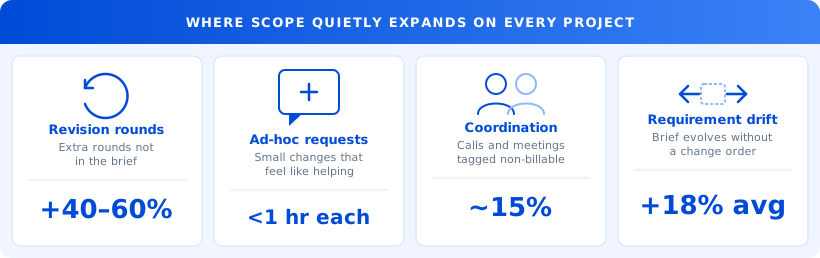
Scope creep does not come from one big request. It comes from four recurring patterns that become invisible over time.
Unplanned revision rounds. The brief said two rounds of revisions. The client sent feedback after delivery, you incorporated it. They sent more. Each round feels like customer service, not scope. Log every revision as a separate task and most projects run 40–60% more revision time than the original estimate included.
Ad-hoc client requests. Quick questions, design tweaks, copy changes, "can you just add one more thing." Each is under an hour. None feel worth a scope conversation. Together, they are often the biggest gap between what you estimated and what you delivered.
Internal coordination overhead. Status meetings that go long. Re-aligning team members after a client direction change. Revising documentation because the brief evolved. Most teams tag this as "internal admin" out of habit, not because the contract excludes it.
Requirement drift. The scope document said one thing in week one. By week four, small decisions have moved the requirements. Nobody changed the contract. The team adapted because adapting felt easier than the conversation. The work expanded. The invoice did not.
Pick one active project right now and count every task added after the original estimate was signed. Tally the hours. That number is your scope expansion rate. Most agencies find 15–25% when they look for the first time.
What tracking scope actually looks like in practice
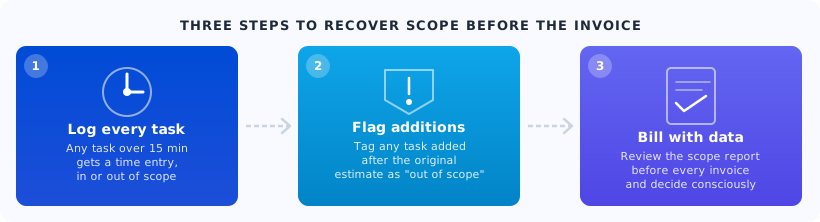
The fix is not a complex process. It is one habit: every task that touches a client project gets a time entry, even if it takes 15 minutes.
The mechanics matter. If your team has to navigate to a spreadsheet, find the right row, and type in a time manually, they will skip it for anything under 30 minutes. The friction of logging needs to be lower than the friction of not logging.
What changes when every task is tracked:
You see scope expansion in real time. When a project's logged hours hit 80% of the estimate, you know before the invoice deadline. That window is when the client conversation happens, not when you are writing the invoice.
Revision rounds become visible. "We have delivered three revision rounds on this project so far. The agreement covers two. Here is a log of the work. We would like to discuss how to handle additional rounds going forward." That conversation is only possible when you have the log.
You know what is billable in your retainer. Most retainer agreements cover client calls, coordination work, and status reporting. Most teams categorize those tasks as non-billable admin by habit. Pull the actual contract language. You will often find the work you are doing is already covered.
Trakkar's task and project management lets your team log time directly against project tasks, including tasks added after the original scope is set. The time tracking keeps a running total against each project's estimate so you see budget consumption before the invoice, not after. And invoice management pulls from those logs directly, so out-of-scope hours are already there when you need them.
"We knew we were doing extra work. We just didn't have anything to point to. Once we started logging every task against the project, the billing conversations changed completely."
What this looks like with real numbers
A content and SEO agency ran 8 active retainers, each valued at $4,500 to $7,000 per month. They estimated each at 40–55 hours of work.
When they audited one retainer month against actual logged hours, they found 61 hours worked on a 50-hour estimate. The 11-hour gap broke down like this:
- 4.5 hours: ad-hoc client feedback calls not in the retainer agreement
- 3 hours: revision round three on a deliverable the agreement covered for two
- 2 hours: status reports in a format the client requested mid-month
- 1.5 hours: coordinating a third-party vendor the client brought in without notice
None of those tasks had been tracked separately. The agency had delivered $990 in unbilled work on a single retainer, in a single month.
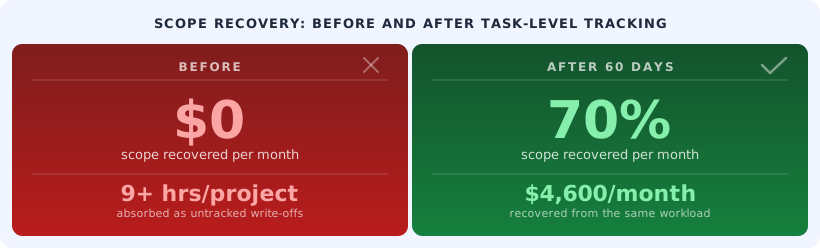
They ran the same audit across all 8 retainers. The average gap was 9.2 hours per retainer per month. At $90 per hour, that was $6,624 per month in unrecovered work.
They did not change their pricing. They did not renegotiate retainers. They added task-level time logging and a 20-minute weekly scope review. Within 60 days, their recovery rate on out-of-scope work went from effectively zero to about 70%.
What to do this week
Day 1: Pick one active project and audit the scope gap. List every task completed since the original estimate was signed. Mark which were in original scope and which were not. Total the out-of-scope hours. That number is your baseline.
Day 2: Read your retainer and project agreements. Look at the actual scope language on your three largest contracts. You will probably find that several things your team calls "internal admin" are explicitly covered in the agreement.
Day 3: Set a 15-minute logging rule. Any task over 15 minutes that touches a client project gets a time entry with a task name, even if the task was not in the original scope document. Enforce this for 10 working days before deciding whether it is working.
Day 4: Create an "out of scope" task category. When a task is added after the original estimate, it goes in this category. This gives you a clean report at invoice time without mixing scope additions into your core project metrics.
Day 5: Run a scope report before your next invoice. Pull all tasks in the out-of-scope category. Total the hours. Decide which to bill for, which to absorb, and which require a conversation. That conscious decision is worth more than accidentally absorbing all of them.
You do not need to bill for every out-of-scope hour. Sometimes absorbing a small task is the right commercial decision. But the decision should be conscious, not invisible. You can only make it consciously when you can see the data.
One concrete next step
If you want to see how much your current projects have drifted from their original estimates, Trakkar can show you that in a 20-minute demo. You will see how scope logging works in practice and what a scope summary looks like before an invoice goes out.
See how Trakkar works for agencies, or book a 20-minute demo and we will look at your scope gap together.