Someone on your team logged out at 5:30pm on Tuesday. You know this because the timesheet says so. What you don't know is that she was answering client Slack messages until 6:45pm, and was back online the next morning at 8:10am, forty minutes before her official start time.
That unrecorded work is not a discipline issue. It's not fraud. It's what happens when distributed teams use systems built for people who sit in the same building and punch the same clock.
The problem is not those 90 minutes. The problem is that same 90 minutes happening in a dozen different ways, across your whole team, every week, with no record that any of it occurred.
For a 10-person distributed team, three attendance gaps per person per week averaging 20 minutes each translates to 520 hours of untracked activity per year. At an average billing rate of $75 per hour, that's $39,000 sitting in a grey zone where neither you nor your client can verify what happened.
What an attendance gap actually looks like
Most ops leads think attendance gaps mean someone didn't show up. That's rare. The real gaps are smaller and happen constantly.
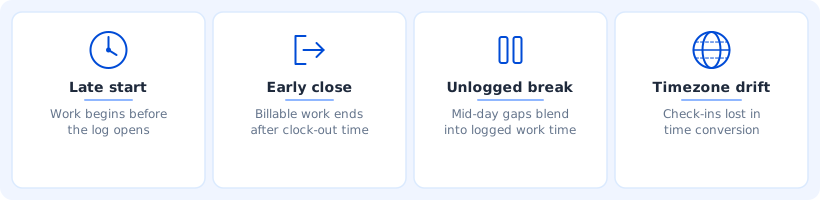
The late start nobody notices. Your Sydney contractor starts work at 8:05am local time because she had school drop-off. Her official hours begin at 8:30am. Her timesheet says 8:30am because that's what the system expects. The 25 minutes from 8:05am were real work: email triage, Slack catch-up, an urgent reply to a client in London. None of it is logged.
The early close that looks complete. Your developer finishes a sprint task at 4:45pm on a Friday and closes his laptop. His contracted hours run to 5:30pm. He did real work from 8:30am to 4:45pm. The timesheet says 8:30am to 5:30pm. Now nobody knows if those last 45 minutes were worked or not.
The mid-day gap with no label. A two-hour lunch that was really a one-hour lunch and one hour of emails and a client reply. The personal errand that bled into a follow-up call. These micro-gaps appear as uninterrupted work hours on paper.
The cross-timezone confusion. Your team spans three time zones. Someone clocks in and out relative to their local business hours. Your project tool, invoicing system, and payroll platform each reference different timezone offsets. The data is technically accurate and practically unreadable.
If your team works across more than two time zones and reconciles attendance manually, the margin of error in your timesheet data is 15% or more. That's before you've looked at individual gaps.
The math your payroll department isn't running
Attendance gaps cost money in three ways that don't surface as a single line item on any report.
The first is unrecorded billable work. If your team does client work outside their logged hours, that work is delivered but uncharged. Unlike project-level time leakage, attendance gaps are harder to catch because there's no project code to flag.
The second is payroll inaccuracy. In both directions. You may be paying for hours not worked, or not paying for hours that were. For distributed teams with contractors across multiple countries, this creates compliance exposure.
The third is retrospective time disputes. When a client questions an invoice, or an employee disputes a payroll calculation, you need a reliable record of when people were active. A manually-submitted timesheet is not that record.
Run the numbers for your own team. Take your headcount, multiply by three gaps per week, multiply by 20 minutes, convert to hours, and multiply by your billing rate. Most ops leads who do this for the first time get a number they don't want to say out loud in a team meeting.
Why the spreadsheet never catches up
The default fix is to add a policy: "everyone submits their timesheet by Friday at 3pm." This creates the appearance of discipline without solving the underlying problem.
Human memory of attendance patterns degrades fast. By Friday afternoon, your team is reconstructing Tuesday from context clues: which Slack channels they were in, which calendar invites they accepted, which tasks changed status. The result is not a record of what happened. It's a plausible estimate that fits the hours the system expects.
"We had a 95% timesheet submission rate and our attendance data was still basically fiction. Everyone filed on time. Nobody was filing accurately."
The second failure is that spreadsheets have no concept of a gap. They show you what was submitted. They cannot show you what was missing. A system that only captures what people logged cannot surface the hours that were never recorded.
What a working attendance system does differently
The difference between a working attendance system and a broken one is not the form. It's whether the system captures what actually happened or only what was submitted.
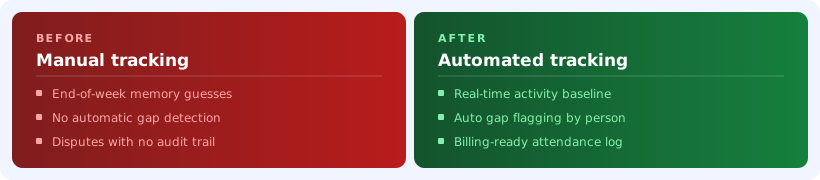
A system that works starts a record when work begins, not when someone remembers to check in. It creates a baseline of actual activity that the team can reference when completing their logs. It surfaces gaps automatically, so a manager sees "Priya was active from 8:10am but logged 8:30am" as a data point to reconcile, not a behavioral verdict to judge.
This is the difference between attendance management as a control system and as an accuracy tool. The first creates friction. The second creates fidelity.
When attendance data is accurate, three things get easier. Payroll reconciliation takes minutes instead of hours. Client billing for time-and-materials projects rests on records rather than estimates. And when someone claims they worked late on a project, you can confirm it without asking them to prove it retroactively.
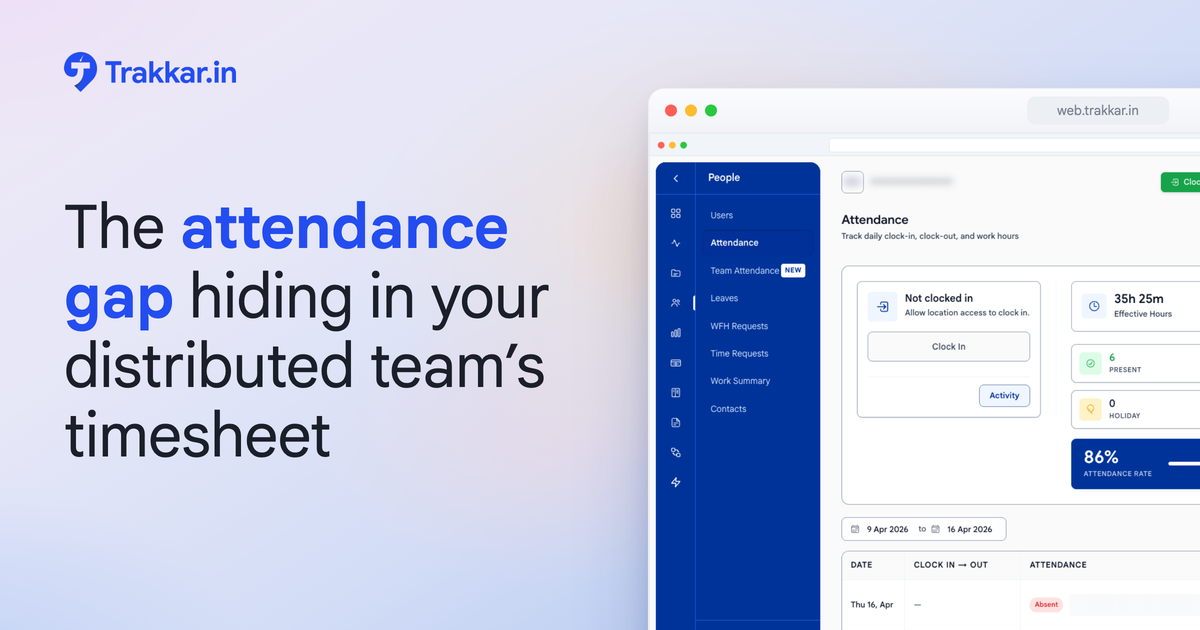
Trakkar's attendance management records actual clock-in and clock-out activity as it happens. It flags gaps automatically on days where logged hours don't match activity data. Reports and analytics then surfaces those gaps by person and week, so you have a specific number to work with rather than a general suspicion.
What one agency found in 60 days
A 14-person digital agency running a mix of full-time staff and hourly contractors ran a 60-day attendance audit after a client disputed a 12-hour invoice line.
They had been using manual timesheets. Weekly submission, manager approval, Xero export. Their submission compliance rate was above 90%.
When they compared submitted timesheets against actual activity logs for the same period, they found a consistent gap of 2.1 hours per person per week. Across 14 people over 60 days, that was 246 hours of unverified activity.
Of those 246 hours, roughly 60% was work that happened but was never logged: late finishes, early starts, mid-day catch-ups. The remaining 40% was hours logged where activity was unverifiable.
The issue was not that people were dishonest. It was that the system gave them no accurate reference point for their own hours. Once they had one, the gap closed without a single policy change.
What to do this week

You don't need a new system to start closing this gap. You need five specific actions before next Friday.
Day 1: Pull last month's attendance data and look for variance. Take one week of timesheets and check them against any activity data you have: Slack, email, project tools. Flag any person whose logged hours differ by more than 30 minutes per day on three or more days.
Day 2: Interview two people in different time zones. Ask them to walk you through their actual Tuesday. What time did they start checking messages? When did they stop for the day? Compare their answers to their logged hours. The gap will tell you something.
Day 3: Add a grace window and a required reason field for gaps. If someone's logged hours fall outside the window of their last recorded activity, they explain it in one line. Not as punishment, just as a record. This creates accountability without surveillance.
Day 4: Set up a gap report for the coming month. Define what a gap looks like for your team: any day where logged hours deviate from activity-based hours by more than 20 minutes. Review it weekly, not monthly.
Day 5: Decide which number matters most. Is your primary risk billing accuracy, payroll compliance, or contractor verification? The answer determines which part of your attendance system to fix first. Don't try to close all three gaps at once.
Start with what you can see
The attendance gaps in your team's timesheets are not hidden. They're just in a format that doesn't surface them automatically.
If you're running a distributed team and reconciling attendance from memory and manual submissions, the gap between what your timesheets say and what your team actually worked is almost certainly larger than you expect.
See how Trakkar handles attendance for distributed teams, or book a 20-minute demo and we'll walk through your team's specific attendance gap before the call is over.