Informal leave policies cause missed deadlines
Your project lead commits to a sprint on Thursday afternoon. She checks the project board, sees the work scoped, and sends the client confirmation.
Monday morning, she finds out her lead developer took two days off. He mentioned it to a colleague in Slack three weeks ago and got a thumbs-up. That was the system.
The deadline moves. The client notices. The client starts thinking about alternatives.
This is not a project management failure. It is a leave-visibility failure. It plays out at almost every agency that grows past eight people without updating how leave works.
The cost is not just the missed deadline. Research on client retention in professional services is consistent: clients who experience avoidable delivery delays are three to five times more likely to reduce spend at the next contract renewal. One recoverable miss costs what it takes three excellent deliveries to earn back.
Why "just ping me" stops working
Most agencies land on the same informal system because it works when the team is small. Someone messages their manager, the manager says yes, and either person may or may not update a shared Google Calendar.
At five people, everyone knows what everyone else is doing. The system is your collective memory.
At fifteen people, that stops working entirely.
Leave gets approved across three different channels: Slack, WhatsApp, and email. The shared calendar has four people with edit access and two who have stopped maintaining it. The project lead does not know she is supposed to check it before planning. The manager who approved the leave forgot to tell anyone else.
No one is being careless. The system is just built for a team that no longer exists.
The three ways it breaks
When informal leave tracking fails, it fails in one of three patterns.
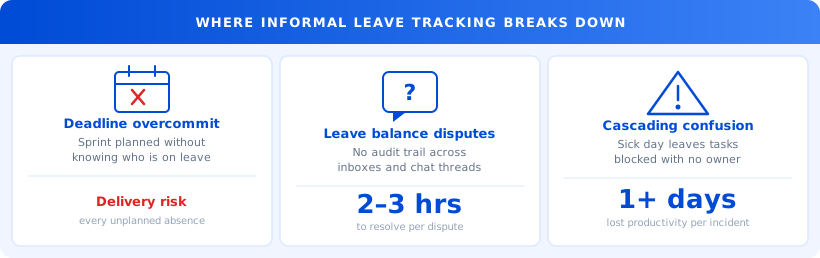
Deadline overcommitment. A project lead plans a sprint assuming full-team capacity. One or two people are on approved leave she did not know about. The team under-delivers against a commitment the client already budgeted around. Recovery requires either overtime from the remaining team or a difficult client conversation.
Leave balance disputes. An employee believes she has taken six days this quarter. HR's spreadsheet shows eight. Neither has a clean audit trail. The investigation takes two to three hours across inboxes and old Slack threads. In a 12-person team, this happens multiple times per year.
Cascading sick-day confusion. Someone calls in sick. Their tasks are blocked. The rest of the team does not know whether to reassign for the day or hold. One day turns into two. The project board has stalled tickets and no clear owner.
The math behind the pain
When an agency loses a client, the revenue loss is obvious. What gets underestimated is what it costs to replace that client.
New client acquisition at most agencies costs six to twelve months of that client's monthly fee in pitch time, proposal work, onboarding, and ramp-up. A client billing $5,000 a month costs between $30,000 and $60,000 to replace in team hours, before counting any discounts given during the pitch.
The less dramatic but more frequent cost is manager time. Checking who is out today. Cross-referencing leave requests with the project board. Figuring out whether a missed milestone was a capacity problem or a performance problem.
At a 15-person agency, that coordination work runs four to six hours per manager per month. At a billing rate of $60 per hour for manager time, that is $240 to $360 per month spent on a problem a central system solves in minutes.
Important
If your team has more than eight people and leave is tracked through a mix of Slack, WhatsApp, and a shared calendar, you are managing with a system built for half your current size.
What good leave visibility looks like
The fix is not a new process. It is a system that makes the right information available without anyone having to chase it.
When a team member submits a leave request, it routes to the right approver automatically. When it is approved, it shows up immediately in a view that project leads can check before committing to timelines. The approved leave sits in the same place as the attendance record, so the person planning next week's sprint does not need to cross-reference three different tools.
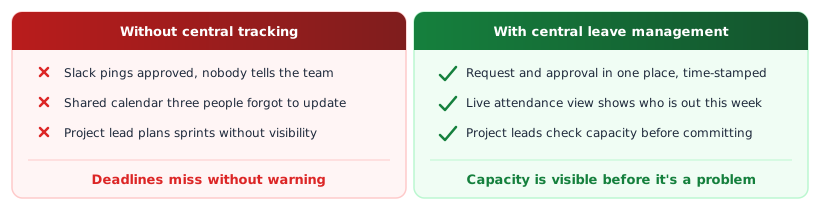
This is what Trakkar's leave management handles. Leave requests come in through one place. Approvals happen there. Approved leaves show up in the attendance dashboard, which project leads can reference before planning. No separate calendar to maintain. No Slack threads to track down.
The team productivity view lets an ops lead see at a glance who is available this week and who is out, without asking anyone. When capacity changes, the view updates.
For agencies running five or more concurrent client projects, this kind of visibility is what separates reactive firefighting from actual capacity planning.
"We had a retainer client complain that we were always scrambling. It wasn't the work, it was that we were constantly surprised by who was available. Once we had one place to see leave and attendance, the scrambling stopped."
What a 12-person agency found
A content and design agency running eight active retainers switched to a central leave system after three deadline incidents in six months. All three had the same root cause: a project lead committing capacity without knowing someone was out.
Before the change, leave was tracked across Slack pinned messages, a Google Calendar that three of eight team members updated consistently, and manager memory. Leave balance disputes came up roughly once per quarter.
After centralizing, the project lead started checking the availability view before every sprint commitment. In the first month, she caught two capacity conflicts that would have caused client delivery problems. No deadlines were missed.
Leave balance disputes dropped to zero. Every request and approval was time-stamped and searchable.
What to do this week
You do not need a new process or a three-month rollout. Here is what you can do in the next five working days.
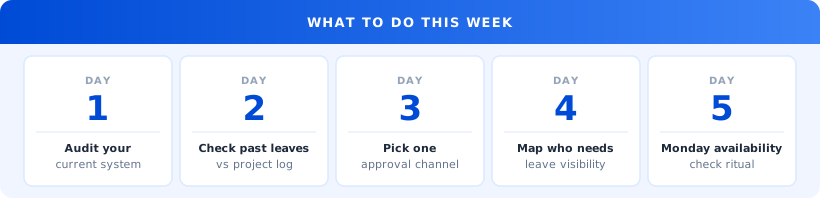
Day 1: Audit your current system. Write down exactly how leave is requested, approved, and communicated to the project team. Count how many steps involve someone manually relaying information. Every manual relay is a failure point.
Day 2: Check last month's leaves against your project log. For any deadline that was missed or nearly missed, check whether anyone on the responsible team was on approved leave. You may find a pattern you had not connected before.
Day 3: Consolidate to one approval channel. If leave requests currently arrive through Slack, WhatsApp, email, and in-person conversation, pick one and tell the team. Even before you have a system, one channel removes most of the information scatter.
Day 4: Map who needs leave visibility before they commit to timelines. Usually this is two or three people: the project lead, the ops lead, and whoever owns client communication. Make sure all three are in the same information loop.
Day 5: Start a Monday availability check. Before the project board is touched on Monday morning, the project lead checks who is out that week. Five minutes. It catches the week's conflicts before they become the week's fires.
Tip
If you can only do one thing this week: ask every project lead whether they knew the leave status of their full team before they committed to timelines last month. The answers will tell you exactly how urgent this is.
One concrete next step
If your team has grown past eight people and leave is still managed through Slack pings and a shared calendar, you are one absence away from a preventable deadline miss.
Trakkar's leave management gives every team member one place to request leave, and every manager one place to approve and track it. Project leads get a live view of who is available before they commit.
See how it works for agencies, or book a 20-minute demo and we will show you your team's current capacity blind spots in the first ten minutes.