How your leave calendar is quietly breaking your project deadlines
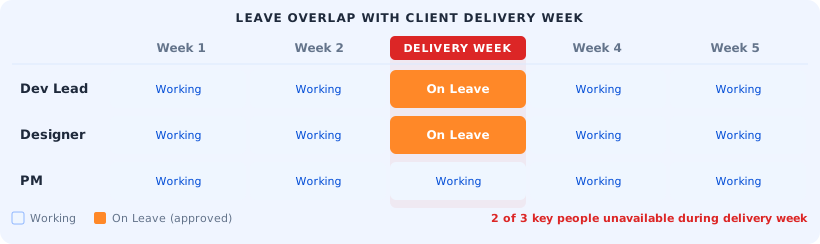
Three members of your nine-person team submitted leave requests for the same week. All three were approved. The final delivery for your biggest client project is that Friday.
You found out on Monday morning. By then, flights were booked, the client's review meeting was in the calendar, and your options were overtime, delay, or both.
This is not a story about a difficult week. It is a story about two systems that never talk to each other. Your leave calendar lives in one tool. Your project schedule lives somewhere else. Nobody's job is to cross-reference them before the approvals go through.
Research on workforce productivity shows that unplanned coverage gaps during key delivery periods drive up to 40 percent productivity loss for the period affected. Most of those gaps are not "unplanned" in the traditional sense. They are planned leave that nobody checked against planned delivery commitments.
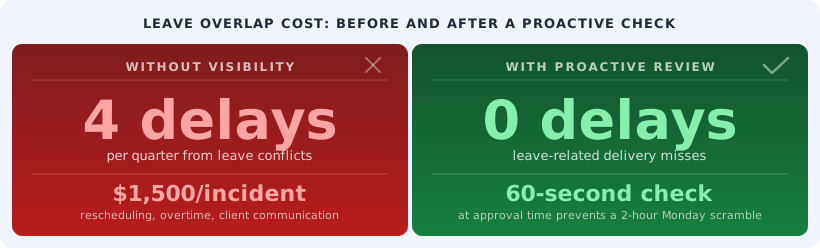
For a 10-person agency, one leave-overlap crisis week costs an estimated $900 to $1,500 in rescheduling, client communication, and overtime. That is a conservative number. It does not count the client trust at risk when a delivery slips with no warning.
Why the two systems never meet
Leave approval is a one-way check. When a manager approves a leave request, they typically verify two things: does the employee have the available balance, and is anyone else already off that day?
That is it.
What they do not check: whether the employee is the lead reviewer on a client deliverable due that same week. Whether their absence drops the available team size below what is needed to hit a sprint target. Whether two other approvals granted last week have already created a coverage risk that this new request pushes past the breaking point.
This check never happens because it requires looking at two different systems at once. The leave tool is in one tab. The project schedule is in another. The mental model connecting them lives, usually, only in the head of the project manager. And that person is not always in the approval loop.
The four signals you already have but are not reading
Most teams have enough information to catch leave conflicts weeks in advance. The data is there. The process to connect it is not.
Signal 1: Approved leave landing inside a delivery-critical week. When your team log shows a key person absent the week a major deliverable is due, that is a signal worth 60 seconds of attention. It is not automatically a problem. Checked against the project schedule, it either clears or it flags.
Signal 2: Multiple leaves stacking in the same two-week window. Three people taking separate leave in weeks two, three, and four of a sprint can gut delivery capacity even when each approval looked fine in isolation.
Signal 3: A delivery-critical person on leave with no named backup. Senior reviewers and project leads often sit on single points of failure for specific deliverables. One week of absence with no backup assigned means the deliverable waits. Nobody flagged it because the leave itself looked unproblematic.
Signal 4: Delivery milestones falling at month or quarter end. People take more leave around the ends of months and quarter boundaries. Final deliverables tend to cluster there too. The overlap is predictable and almost never tracked.
Important
Take your next 60 days of delivery milestones and your current approved leave calendar. Overlay them. Any week with a final delivery AND a key team member on leave is a risk you need to address today, not the Monday morning it becomes a crisis.
What the fix actually looks like
The process change is simple. The consistency is what most teams skip.
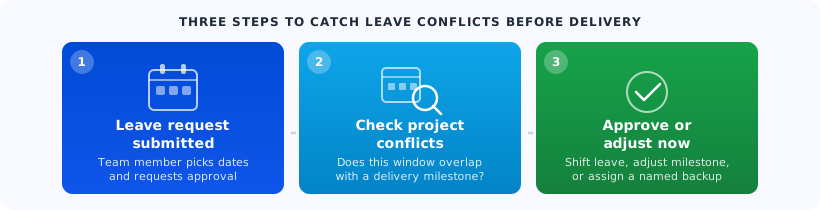
Before any leave request for a delivery-critical team member is approved, one person checks the project schedule for that window. That check takes 60 seconds with a visible project calendar. The outcome is one of three things: approve as is when there is no conflict, approve and proactively adjust the delivery date, or have a conversation with the team member about shifting the leave by a few days.
That one-minute check at approval time prevents a two-hour scramble at delivery time.
What "visible project calendar" means in practice: a single view showing who is available each week alongside what is due each week. Most teams try to build this in a spreadsheet, update it inconsistently, and abandon it within a month. What actually sticks is a system where the leave request itself surfaces whether a delivery window is at risk.
Trakkar's leave management shows team-wide leave across a calendar view so you can see, before approving, whether a window already has coverage pressure. The attendance management view gives you a real-time read on who is actually available. And task and project management lets you map delivery milestones against team availability before a leave decision is finalized.
"We used to approve leave and hope for the best. Now we check the project calendar first. We have not had a leave-related delivery delay in four months."
What this looks like with real numbers
A 12-person content agency ran four active client retainers with weekly deliverables: brand newsletters, weekly status reports, a content calendar, and social media scheduling.
Leave was tracked in a Google Sheet. Approvals went to a department head who had no visibility into the project schedule.
In one quarter, four delivery weeks had at least one missed or rescheduled deliverable. When they traced the cause of each delay, three of the four came back to a leave overlap:
- Week 6: The senior editor was on approved leave. The newsletter draft had no designated reviewer. It went out two days late.
- Week 9: The project lead and a junior designer both took leave the same week. Social media content required sign-off from both. Friday's scheduled post went live the following Tuesday.
- Week 11: A key contractor took an unplanned sick day during the week a major quarterly report was due. No backup existed. The report arrived 36 hours late.
The client on the quarterly report delay did not renew their retainer. That contract was worth $6,200 per month.
When the agency added a pre-approval check against the project schedule, they caught three potential conflicts in the next 60 days. Two were resolved by shifting leave dates by two to three days. One required moving a delivery milestone one week earlier, before the client ever knew a change was being considered.
The following quarter: zero leave-related delivery delays.
What to do this week
Day 1: Run a 60-day overlap audit. Pull approved leave for the next 60 days. Pull delivery milestones for the same window. Highlight every week where a milestone falls within five business days of an approved leave for a delivery-critical team member.
Day 2: Flag your two highest-risk weeks. Pick the two where the coverage gap is most likely to affect a client commitment. Decide now: adjust the delivery date, shift the leave timing, or assign a named backup. Do this before both are locked.
Day 3: Add one question to your leave approval process. Before any senior team member's leave is approved, the approver checks: "Is this person the lead on anything due during their leave window?" A 60-second check. No new software required.
Day 4: Create a team availability view for the next 8 weeks. A simple list: each week, who is available and what is due. Update it every Friday. This one habit changes how your Monday planning meetings start.
Day 5: Track leave-related delays for 8 weeks. Every time a project misses its date, note whether a team member was on leave that week. After 8 weeks, you will have a clear read on how much your current process is costing you.
Note
The goal is not zero leave. A team that cannot take time off without risking client commitments has a capacity problem, not a leave problem. That problem only becomes visible when you can see availability and delivery commitments in the same place at the same time.
One concrete next step
If you want to see how your project schedule maps against your team's upcoming leave, Trakkar can walk you through it in 20 minutes.
See how Trakkar handles leave management for agencies or book a 20-minute demo and we will look at your next 60 days of delivery risk together.