Your project slipped three days because someone was on leave. You found out too late.
It happens the same way every time.
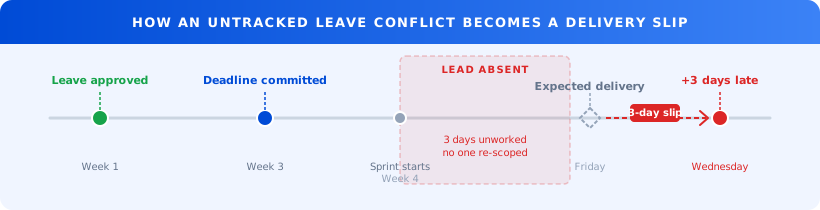
A client deadline slips by three days. You pull the project and see the lead developer was active for only two of the five sprint days. You check the leave record. He had approved time off from Wednesday to Friday. You check when the delivery date was committed. Two days after the leave was approved.
Nobody flagged the conflict. Nobody checked availability before the date went into the client email. Now you are writing an apology to a client who expected delivery on Friday and will get it Wednesday.
This is not a scheduling failure. It is a visibility failure. Leave approvals and project plans lived in different places, and nobody's job was to reconcile them before the commitment was made.
For a 10-person agency running four active retainers, this kind of collision happens roughly once per quarter. Each incident costs an average of 6 to 10 hours in rework, client communication, and replanning. At $85 per hour, that is between $510 and $850 per incident. Four incidents per year puts you at $2,040 to $3,400 in recovery work that generates zero billable revenue, before you count the renewal friction and the upsell you did not get.
Why leave tracking falls apart for distributed teams
The problem is not that people take leave. Leave is budgeted and expected. The problem is that leave approvals live in one system and project commitments live in another, and the two are rarely reconciled before a deadline goes out.
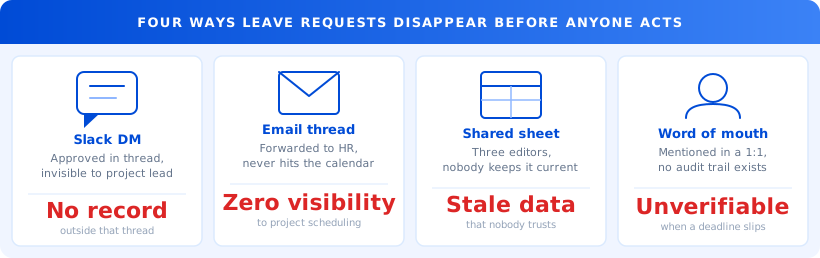
Slack DMs that nobody archives. "Hey, I need Thursday and Friday off." "Sounds good." That exchange lives in a direct message between two people. The project lead, the account manager, and the person setting the delivery date never see it.
Email approvals that stop at HR. A leave request goes to the ops lead's inbox. It gets approved and filed. It never reaches the project calendar or the sprint board. The approval is complete. The visibility is zero.
Shared spreadsheets nobody trusts. Three people have edit access. Two forgot the URL. The last update was six weeks ago. The data is plausible but not reliable, so nobody checks it before committing a date.
Verbal approval in a one-on-one. "I mentioned it in our weekly." Nobody disputes it. Nobody outside that meeting knows about it. There is no audit trail.
Important
If your leave requests are approved over Slack or email and never synchronized to a project calendar, you have no way to check team availability before committing a delivery date. The next conflict is already in progress.
The math on your specific team
Run this once.
Take your team's leave days per year. Fifteen days per person is a reasonable floor. For a 10-person team, that is 150 person-days of leave annually. If just 15 percent of those create scheduling conflicts because nobody checked project load before approving, you have 22 to 23 conflict incidents per year.
Each incident averages 4 to 8 hours of recovery work at your blended rate:
22 incidents × 6 hours × $85 = $11,220 per year.
None of that is billable. All of it is avoidable.
Scale to 20 people and the number doubles. Add timezone complexity and that 15 percent conflict rate is probably conservative.
Tip
Run this with your actual numbers: incidents per year × average recovery hours × your blended rate. Most ops leads who do this find the annual cost exceeds what a proper leave management tool would cost to run.
Why a shared calendar does not fix this
For a six-person team in one timezone, a shared Google Calendar works. For a 15-person agency spread across three timezones with five active projects, two part-timers, and overlapping retainer cycles, it breaks.
The issue with a shared calendar is that checking it requires intention. Somebody has to remember to open the tab, find the right person, look at the right week, and then cross-reference with the project schedule before setting a deadline. That is four manual steps, and they have to happen before the commitment is made, not after.
When a team is moving fast, those steps get skipped. The deadline goes out. The leave period arrives. The gap appears.
"We had the leave calendar. We had the project plan. They just lived in different places, and nobody's job was to check both before we sent the client a date."
The teams that stop having this problem do not use a better calendar. They use a system where leave data and project planning live in the same place, so conflicts surface automatically during approval, not after a deadline slips.
What working leave visibility looks like
The fix is simpler than most ops leads expect. Three things make the difference.
One channel for all leave requests. Every request goes through a single workflow. Not Slack, not email, not a verbal mention. One place. This creates an audit trail and makes the data visible to anyone who needs it.
Approval tied to a project-load check. Before a leave request is confirmed, the approver sees what is scheduled for that period. Not as a separate step that might be skipped, but as part of the approval flow.
Leave visible to project leads before deadlines are set. When a project lead is planning a sprint or committing a delivery date, they can see who is available and who is not, without switching applications.
Trakkar's leave management connects approval workflows directly to attendance records so every leave request is visible alongside team availability. When you open a project and assign a deadline, you can see who is out during that window before the client gets a date in their inbox.
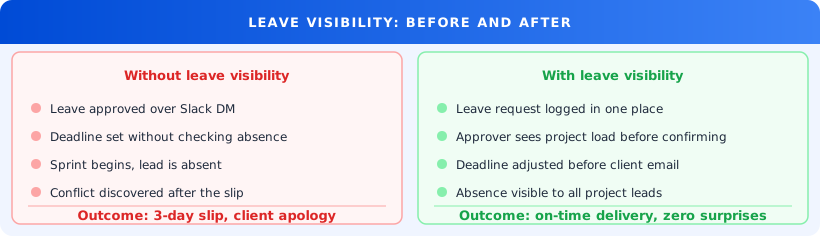
That is not a complex system. It is a connected one.
What a 12-person agency changed
A content agency with three editorial retainers and a 12-person team was averaging one delivery slip per month. Every post-mortem pointed to the same root cause: someone was on approved leave during a critical sprint window and no one had checked before the deadline was committed.
The ops lead made one policy change. All leave requests had to go through a central tool before any Slack or email confirmation. Approval required a project-load check. Once approved, the absence showed up automatically in the planning view.
Within 60 days, unplanned delivery slips dropped from monthly to quarterly. The team did not work more hours. Clients did not change their expectations. The only thing that changed was that approvals and project plans were finally in the same place.
What to do this week
Day 1. Audit where leave requests currently land. If the answer includes Slack threads and email replies, you have no reliable record and no way to cross-reference availability before making commitments.
Day 2. Pull your last 90 days of project slips. Count how many post-mortems mention "availability," "team was short," or "lead was out." Two or more means leave conflicts are already costing you at a measurable rate.
Day 3. Before approving any leave request this week, open the project schedule and check what is assigned during that window. Do it manually, even if the process is slow. The friction you feel is the cost you have been absorbing silently.
Day 4. Set one rule: no leave approved without a project-load check first. This costs nothing and adds two minutes per approval. It prevents the next slip.
Day 5. Review your next six weeks of committed deadlines against any leave you know about. Find the conflicts now while you can still adjust dates or manage client expectations before the gap appears.
Note
Start with one policy change this week: no leave approved without checking the project schedule. You do not need new software to do this. You need a habit. The software makes the habit easier to keep.
One concrete next step
Trakkar's leave management connects approval workflows to team availability so the conflict shows up during planning, not in a client apology. If you want to see how that works alongside your team's actual project schedule, book a 20-minute demo and we will walk through your capacity gaps in the first ten minutes.