Last quarter, a project your team estimated at 80 hours finished at 114. Nobody filed a formal complaint. The project manager marked it as "slightly over," the invoice went out for the estimated amount, and the debrief was skipped because the next project was already behind schedule.
Three months later, you estimated a nearly identical project at 90 hours. It finished at 128.
This is not bad luck. It is what happens when teams estimate from memory instead of data. And it costs the average 10-person agency between 12% and 25% of gross margin every year in unrecovered time.
A 2024 global project management survey found that only 35% of projects are delivered on time and on budget. Among agencies and professional services firms, the overrun rate runs consistently at 30 to 40%. That is not an anomaly. It is what estimation without data looks like.
Why your estimators are not the problem
Most teams blame bad estimates on overly optimistic project managers or clients who quietly expand scope. Both of those things happen. But neither is the primary driver of systematic estimation failure.
The real driver is that most agencies estimate from instinct, not data.
When your project manager estimates 80 hours for a website redesign, she draws on a mental model built from a handful of past projects she remembers well, adjusted by how the current client feels and how busy the team looks. That mental model has no access to task-level time logs, historical revision cycle data, or actual utilization rates at the time those past projects were delivered.
She is doing her best. The system is not helping her.
The planning fallacy, a documented cognitive bias, predicts that people consistently underestimate task duration even after experiencing repeated overruns on similar tasks. The fix is not better intuition. It is external data that overrides intuition.
The four places your estimate falls apart
Understanding where the gap comes from is step one. The miss rarely appears in the headline deliverable tasks.
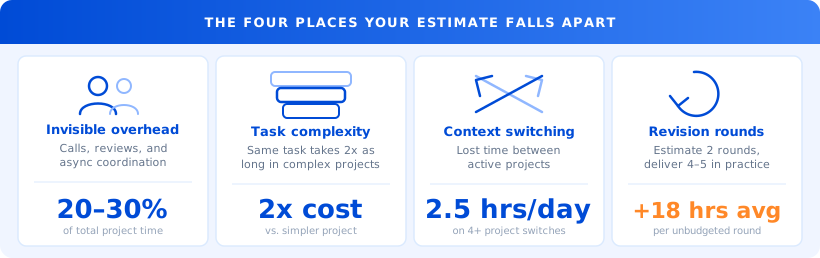
Invisible overhead. Your 80-hour estimate covers design, development, and copy. It does not cover the 14 status calls, 6 async review rounds, and 3 client revision cycles that will happen on any mid-size project. Overhead on a typical agency engagement runs 20 to 30% of the headline estimate. It is almost never explicitly included.
Task complexity versus project complexity. A task that took 4 hours on a simpler project may take 8 hours inside a more integrated system. The estimate uses the simpler number. The actual work produces the larger one. Most time tracking setups do not make this pattern visible because the task is tagged to the project but never compared to a historical baseline.
The context switch tax. A developer switching between 3 active projects loses roughly 20 to 40 minutes per switch to cognitive reorientation. Across an 8-hour day with 4 project switches, that is up to 2.5 hours of lost capacity that nobody estimated for and nobody logs.
Revision rounds without a ceiling. The estimate says two rounds of revisions. The project delivers five. Nobody flags the extra rounds as scope change because they feel like natural iterations. Three unbudgeted rounds at 6 hours each is 18 hours the estimate never accounted for.
If your estimates do not include an explicit line item for client calls, async reviews, and revision rounds, you are systematically underestimating every project before it starts. Add 20 to 25% to any core deliverable estimate to account for coordination overhead before you adjust for task complexity.
What accurate estimation actually needs
The fix is not a better guess. It is a lookup.
When a project manager can pull up the actual time logs from the last three projects of a similar type, she does not need to rely on memory. She can see that the last website redesign took 94 hours, the one before that took 87, and the one before that took 103. The average is 95. The range is 87 to 103. She builds a credible estimate range instead of a single optimistic number.
She can also see where the time went. If client calls consumed 26 hours of the 94 and the estimate only covered 8, she knows to either include that gap in the new estimate or flag it as a scope variable in the contract.
This is what time data does for estimation. It replaces memory with a record.
For this to work, you need three things from your time-tracking system:
- Task-level logging, not project-level totals. A single number for "94 hours on the Acme redesign" tells you nothing useful for estimation. Breaking it down by design, development, QA, calls, and revisions tells you everything.
- Project-type tagging, so you can filter historical data by category. A 5-page informational redesign is comparable. A 40-page e-commerce build is not. Tag your projects at kickoff, not at close.
- Report access, so whoever is building the estimate can run their own lookup without requesting a manual export. If pulling historical time data requires three emails and two days of waiting, it will not get used.
Reading your own time data to calibrate estimates
The fastest way to close your estimation gap is one project audit this week, used to set a new baseline before the next estimate goes out.
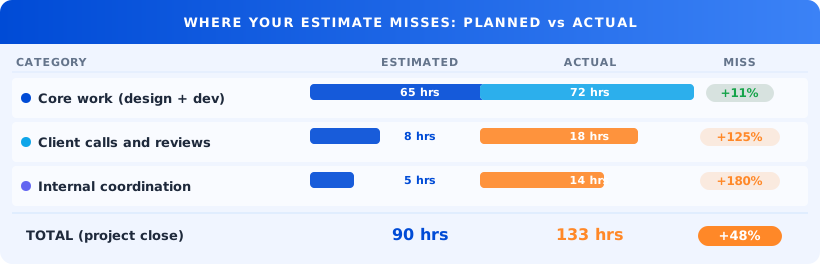
Pull up your three most recent projects of a type you estimate repeatedly. For each one, compare what was estimated at kickoff against what was actually logged by project close. Then break that down by task category.
What you are looking for:
Where the estimate was accurate. Usually the core deliverable tasks, because those are what estimators think about most. These are your reliable baseline.
Where the estimate consistently missed. Usually calls, reviews, async coordination, and revision rounds. These are your systematic blind spots. Add them explicitly to future estimates.
Who drove the overruns. If 60% of the excess hours are concentrated in one person's time logs, it is a capacity or complexity issue specific to that person, not an estimation methodology problem. Handle it separately.
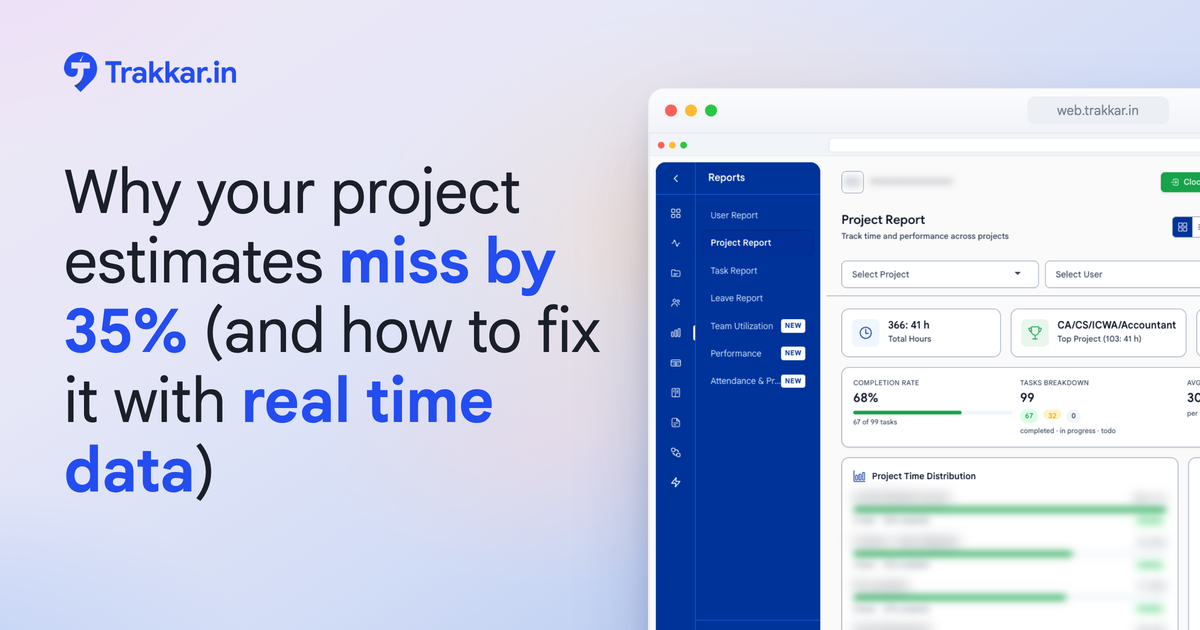
Trakkar's reports and analytics surfaces planned-versus-actual breakdowns by project, person, and task category. You can filter by project type and export a comparison without rebuilding a spreadsheet each time. The time tracking layer captures task-level entries throughout the project, so there is actual data to analyze when estimation time arrives.
For teams running recurring client work, Trakkar's task and project management lets you tag tasks by type and set time budgets at the task level. When actual time starts approaching budget on a specific task, the system flags it before the project runs over, not after the invoice goes out.
What one agency found in a single afternoon
A 12-person digital agency decided to audit their last quarter of project delivery before setting rates for a new enterprise client.
They pulled time logs from 8 completed projects, all website redesigns of roughly similar scope. Their estimates had averaged 82 hours per project. Their actuals averaged 113 hours. The miss was 38%.
The breakdown told them where to focus:
- Core design and development: estimates were off by only 9%
- Client calls and async reviews: estimates covered 12 hours, actuals averaged 26 hours per project
- Revision rounds: estimates assumed 2 rounds at 6 hours each, actuals averaged 4.3 rounds at 7 hours each
"We were not bad at estimating design work. We were just not estimating half of the project."
They rebuilt their estimate template to include explicit line items for client coordination and revision rounds, with a cap written into the contract. On the next 5 projects, their average estimate accuracy improved from a 38% miss to within 11% of actual.
They did not get smarter about estimating. They stopped guessing about the parts they had always ignored.
What to do this week
You do not need a new process or a long rollout. Here is what you can do in the next five working days.
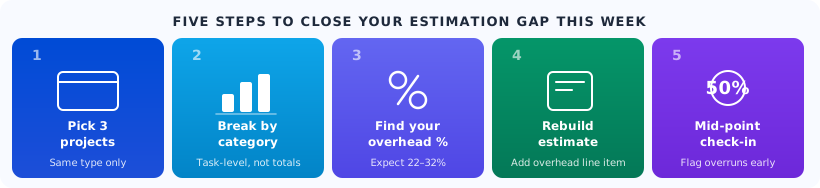
Step 1: Pick your three most recent comparable projects. Choose the same project type: website builds, brand campaigns, or development sprints, whatever your team runs repeatedly. Do not mix types. Mixed comparisons produce numbers you cannot act on.
Step 2: Pull actual logged hours by task category. Design, development, QA, calls, and revisions as separate line items. If your current system only gives you project-level totals, that is your first system problem to fix. You cannot calibrate estimates from totals.
Step 3: Calculate your overhead ratio. Add up all coordination, calls, reviews, and revision hours. Divide by total project hours. This ratio is your systematic underestimate. On most agency projects it falls between 0.22 and 0.32. If yours is higher, your retainer scope or client process needs a direct conversation.
Step 4: Rebuild your next estimate using the baseline. Take the core deliverable estimate and add your overhead ratio on top. Explicitly label revision rounds and cap them in the contract: "This estimate includes two rounds of client revisions. Additional rounds will be scoped separately."
Step 5: Set a mid-project check-in on hours. At 50% of estimated hours, the project manager pulls the actual logged hours and compares to the estimate. If actuals are more than 20% ahead of where the estimate predicted, raise the flag now. Not at invoice time.
The best time to catch an estimate miss is at the 50% hours mark, when you can still reset client expectations before delivery. The worst time is after the project is done and you are deciding whether to invoice for overruns or absorb them. Build the mid-project check into your standard workflow.
See your real numbers before the next estimate goes out
If you want to see your team's actual estimate accuracy by project type before committing to a new client or a new rate card, Trakkar can show you a planned-versus-actual breakdown in a demo.
See how Trakkar works for agencies, or book a 20-minute demo and bring one project that ran over budget. We will show you where the time went, what your real overhead ratio is, and what your next estimate should look like.