You wrote the estimate carefully. You broke the project into phases. You added a buffer for revisions. Your project lead reviewed it. The client signed off.
Eight weeks later, you delivered the work on time and worked 35% more hours than you quoted.
This is not a planning failure. It is a data failure.
The estimate you actually need already exists in your past time logs. Most teams never look at it before writing the next proposal. They rely on memory instead. And memory is consistently wrong in one direction: it underestimates task duration by 20-40% compared to what the time logs actually show.
For a 10-person agency billing 800 hours a month at $75 per hour, that gap costs $12,000 every month in work delivered and never charged. Over a year: $144,000. That is a full senior hire walking out the door because your estimates are built on how things went when everything worked, not on how they actually went across all your projects.
Why careful estimators still get it wrong
Most project leads who struggle with estimates are not careless. They think before they quote. The problem is not effort. It is source material.
Humans estimate task duration by recalling similar past experiences. Your brain says: the last homepage redesign took 60 hours. What it does not say: that one had an experienced designer, a client who approved the brief on day one, and a single round of revisions. The project you are about to quote has four stakeholders and no clear approval hierarchy.
This pattern has a name: the planning fallacy. People consistently forecast task durations based on best-case conditions while discounting the times things went sideways. It is not a flaw in your process. It is how human memory works.
The fix is not to think harder before writing the proposal. It is to replace gut recall with recorded data from your own team, on your own project types, with your own clients.
Four places where every estimate breaks
Estimation failure is not random. It happens in predictable places, and those places repeat across most agencies.
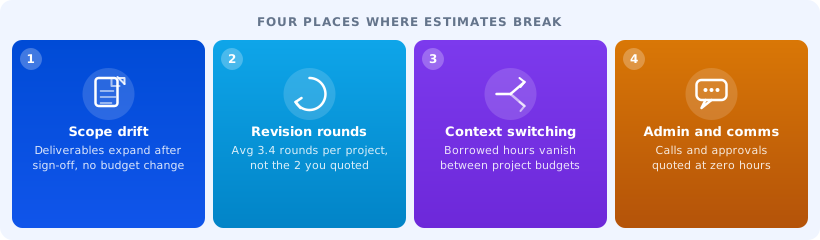
Scope is loosely defined. The proposal says "website redesign." The client hears "full visual rebrand plus new copy plus mobile optimization." These are not the same project. Without a time breakdown by deliverable, you cannot catch that gap until you are already 80 hours in.
Revision rounds are underestimated. Most estimates build in one to two rounds of client feedback. Industry averages for creative and digital work run three to four. If you tracked your last 10 projects, how many came in under two revision rounds? Your time logs have the exact answer.
Context switching goes untracked. A developer pulls off Project A to fix an urgent bug on Project B. Forty minutes of Project B work get absorbed somewhere, and it never makes it into the budget for either project. Without a live timer running, that time disappears.
Admin and communication are estimated at zero. Status calls, approval chains, Slack threads, async video walkthroughs. Most estimates leave them out entirely. On a typical retainer, coordination work runs 15-20% of total project hours.
If your last five completed projects each ran 25-35% over the original estimate, you are not looking at scope creep. You are looking at an estimation baseline built on optimistic assumptions, not actual past data.
What your time logs already know
Every completed project you tracked is a data point. The question is whether you are using it before writing the next quote.
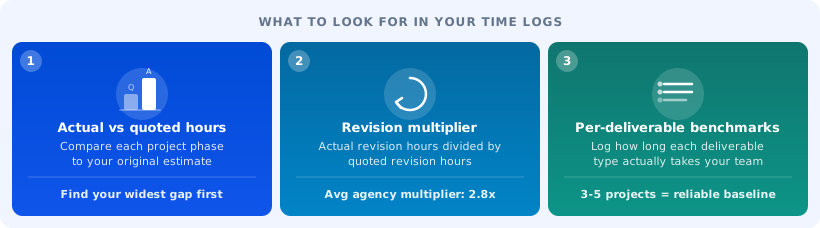
Actual versus quoted hours by phase. Pull the time breakdown on your last three to five similar projects. If you quoted 20 hours for the design phase and it took 31, you have a 55% underestimate on that phase. Find which phase you are furthest off on. That is where your estimate logic is weakest.
Revision cycle multiplier. Take total hours logged on revisions. Divide by the hours you quoted for revisions. If you quoted 5 hours and spent 14, your revision multiplier is 2.8. Apply that to the next similar project instead of assuming this client will be faster.
Time-per-deliverable benchmarks. How long does your team actually take to build a landing page from scratch? Write 1,000 words of copy? Edit one minute of finished video? After three to five tracked projects, these numbers stabilize into reliable benchmarks. Use them instead of gut estimates and industry averages.
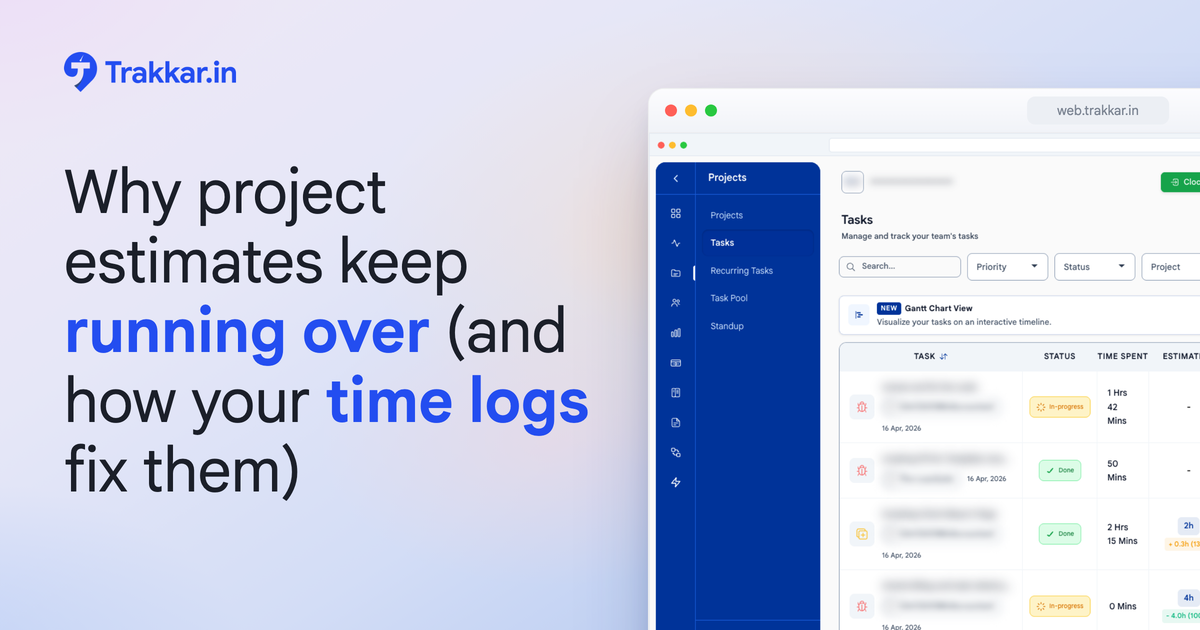
Trakkar's reports and analytics lets you pull actual hours by project phase, team member, and task type, side by side with the original estimate. The task and project management features let you map your next proposal directly to the task breakdown of the most similar past project you completed. And time tracking keeps a live record that holds up when a client questions the final invoice.
One agency's 90 days of data
A nine-person content production agency was consistently underestimating video explainer projects. Their standard quote was 28 hours per video. After running accurate time tracking for 90 days across five completed projects, they pulled the actual breakdown.
Average hours per video: 41.
The numbers were specific:
- Pre-production (scripting, brief): quoted 6 hours, actual 9
- Production (filming, direction): quoted 8 hours, actual 11
- Post-production (editing and revisions): quoted 14 hours, actual 21
Every phase was off. Post-production was where they lost the most. The time logs showed clients were averaging 3.4 revision rounds, not the 2 rounds built into every original quote.
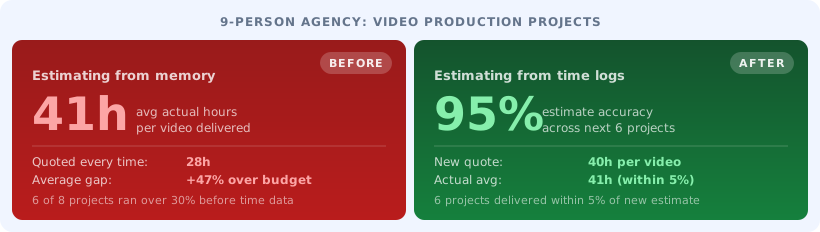
They made two changes. They updated their baseline quote to 40 hours. They added a clear revision-round cap in the contract, with a per-round rate for anything beyond three.
"We were not quoting the project we were delivering. We were quoting the project we hoped to deliver."
Their next six projects came in within 5% of the new estimate. The data was always there. They just had not read it before writing the proposal.
What to do this week
You do not need a new system or a three-month change management effort. Here is what to do in the next five working days.
Day 1: Pull actuals on your last five completed projects. Get hours by project, and by phase if you tracked them. If you only have project totals, that is still a starting point.
Day 2: Calculate your estimation accuracy. For each project, divide actual hours by quoted hours. If the number is consistently above 1.2, your estimates are running 20% or more over. That gap is recoverable with better baseline data.
Day 3: Build a benchmark table. Three columns: project type, quoted hours, actual hours. One row per completed project. This is your reference document for the next 90 days.
Day 4: Find your worst phase. Look at which project phase you most consistently underestimate. Scope definition, revisions, or coordination. Adjust your estimate template for that phase first.
Day 5: Review your next outgoing proposal against the benchmark table. Before you hit send, find the closest matching past project. If your new estimate is more than 20% below actual hours on that past project, explain in writing why this engagement will be different.
Start with one project type, not your whole portfolio. Benchmarking a single project type takes 30 minutes and gives you a number you can use immediately. Doing all types at once takes a week and rarely happens.
One concrete next step
The data to fix your estimates exists in your time logs. The question is whether you can see it clearly enough to use it before writing the next proposal.
If you want to see what your team's historical project data looks like in a structured report, and whether your current estimates hold up against your actual past performance, see how Trakkar works for agencies. Or book a 20-minute demo and we will pull up your estimation gap in the first ten minutes.