Your design team delivered the website on time. The client signed off. You sent the invoice. Then, two weeks later, someone asked a simple question: how many hours did we actually spend on that?
You pulled the numbers. The project was quoted at 80 hours. The team logged 56. But three people had not tracked anything since week two. A quick back-of-napkin estimate puts the real number closer to 90 hours.
You just ate 34 hours. At your standard billing rate, that is roughly $2,550 you worked for but never charged.
Multiply that across four projects a month and you are leaving $120,000 on the table every year without knowing it.
Where the hours actually go
Most agencies do not lose billable time to laziness. They lose it to the gap between when work happens and when it gets recorded.
Research is consistent: agencies relying on end-of-day or end-of-week time entry lose 20 to 30% of billable hours to memory failures and inconsistent logging. Professionals under-report by 15 to 25% on average when reconstructing time from memory.
Here are the four places where your team's hours disappear:
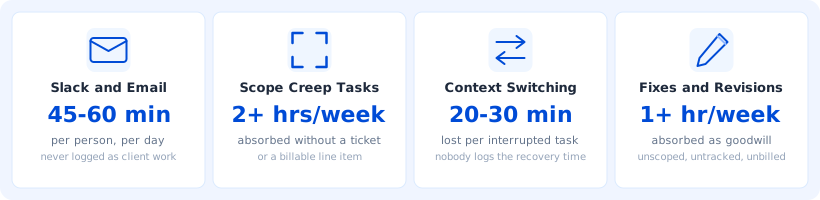
Slack and email absorb 45 minutes to an hour per person per day. Nobody logs this as client work, even when it is.
Scope creep tasks get absorbed without a ticket, without a log entry, and without a billable line item. "While we are at it, can you just..." costs more than any individual change request.
Context switching adds 20 to 30 minutes per interrupted task. Your developer does not log "interrupted by product question, lost context, reoriented." They just move on.
Fixes and revisions that were not scoped get absorbed as goodwill. Sometimes that is right. But when it happens every sprint and nothing is tracked, you cannot tell the difference between genuine goodwill and systematic undercharging.
The math on one missed hour
This is not abstract. Here is what one missed hour per person, per day, actually costs you.
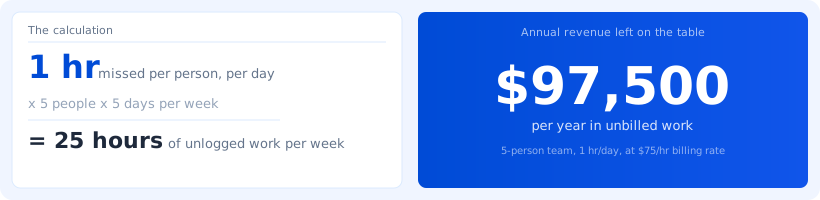
Take a five-person agency team. Each person misses logging one hour per day. Over a five-day week, that is 25 hours of unlogged work.
At a billing rate of $75 per hour, that is $1,875 per week. In a year, that is $97,500 in revenue your team worked for but your invoices never captured.
If your billing rate is $100 per hour, you just found $130,000 sitting in your team's memory gaps.
Even recovering half of that changes your agency's economics completely.
Run this for your own team: (hours missed per person per day) x team size x hourly rate x 22 working days. Most ops leads who do this for the first time are surprised by how fast the number compounds.
Why "track it later" never works
Most teams intend to log time accurately. The problem is reconstruction.
When someone sits down on Friday to fill in the week's timesheets, they are not remembering what they did. They are guessing. They round down, skip the messy middle hours, and forget anything that did not have a calendar event attached.
"I know we spent a lot of time on the homepage revisions, but when I went to log it, I could not remember if it was 3 hours or 6. I split the difference and put 4.5. In hindsight, it was closer to 7."
The problem is not the developer. It is the system. End-of-week logging asks your team to perform forensic archaeology on their own attention. It is unreliable by design.
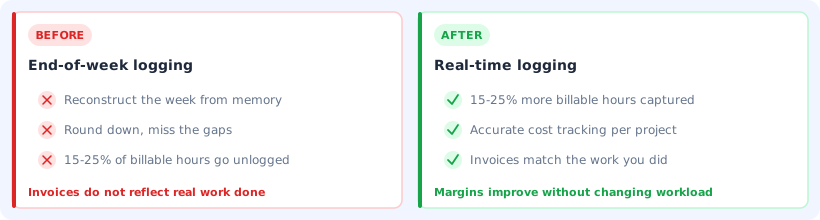
Real-time logging, where people log against a specific project as they work or immediately after a task, consistently captures 15 to 25% more billable time than weekly reconstruction. You do not need a bigger team or longer hours. You need the hours you are already working to show up in your reports.
If your team logs time weekly rather than daily, expect 15 to 25% of your hours to be underreported before you have even looked at scope creep or unbilled tasks.
What a tight tracking setup actually looks like
The goal is not surveillance. The goal is accuracy.
Here is a setup that works for a 10 to 15 person agency:
Project-level time entries. Every hour logged goes against a specific project and task, not a generic bucket. This lets you see, in real time, whether a project is burning through its budget faster than expected. Trakkar's time tracking makes this the default: you pick a project, pick a task, and the timer runs.
A daily close habit. Not a policy mandate, just a team expectation: before you close your laptop, log the day's hours. Fifteen seconds. This is the single highest-ROI behavior change an ops lead can introduce.
Weekly hours-vs-budget reviews. Once a week, check how each project is tracking against its estimated hours. A project at 60% of hours spent but only 30% of deliverables complete is a warning signal, not a crisis yet. Catching it early saves you from writing it off at the end. Trakkar's reports and analytics make this a five-minute Friday ritual instead of a two-hour spreadsheet exercise.
Attendance data as a cross-check. If someone logged 6 hours of work but their attendance shows they were clocked in for 9, there are 3 hours of unaccounted time somewhere. This is not about distrust. It is about giving your team a way to find the gaps before they become invoice disputes.
A real-feeling example
Neha runs operations for a 12-person product design agency in Pune. Every project was scoped, scheduled, and delivered on time. But when her accountant looked at profitability by project, the numbers did not add up. Projects that should have run at 40% margin were coming in at 22 to 25%.
She ran a simple audit: pulled the logged hours for the last three projects, compared them to the team's attendance records, and asked each person to estimate how many hours they actually spent.
The gap was 30 to 40 hours per project. Unlogged, unbilled, invisible.
She introduced two changes: mandatory same-day time logging, enforced by a Friday Slack message rather than software locks, and a weekly 10-minute project check using the hours report in Trakkar's project management dashboard.
"We were delivering the scope and then forgetting to bill for half of it."
Within 60 days, billed hours went up 22% with no change in workload. The projects had not changed. The tracking had.
What to do this week
You do not need a big process overhaul. Start with these five steps:
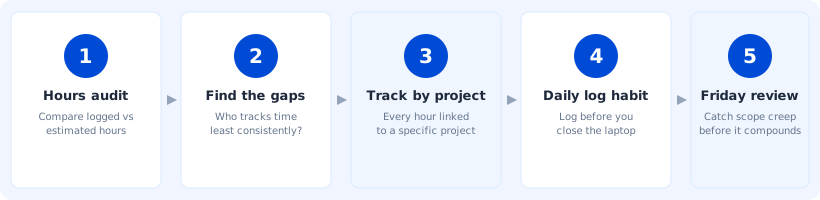
Run a retrospective hours audit. Pick your last three projects. Compare the hours logged against the original estimate. Look for the gap.
Identify your worst-tracked projects. Which team members or projects have the biggest gap between attendance and logged hours? That is where you start.
Set up project-level time tracking. Every new project gets a Trakkar project created before work starts. No project, no logging. This forces the structure.
Introduce a daily log-before-you-close habit. Make it a team expectation, not a policy. One week of nudging usually builds the habit.
Set a Friday hours-vs-budget check. Ten minutes every Friday. Any project over 60% of its hour budget gets a quick review. Catch scope creep before it compounds.
Start with one project audit, not your whole portfolio. It takes 30 minutes and gives you a concrete number to bring to the next team meeting. Doing all projects at once usually does not happen.
If you do only one of these: start the retrospective audit. The numbers will tell you everything you need to know.
Stop letting your team's hours vanish
You are already doing the work. Your team is already putting in the hours. The only question is whether your invoices reflect that reality.
Most agencies that find their billing gap do not need to hire more people or raise their rates. They need to capture what they are already producing.
Trakkar's time tracking and project management tools are built for exactly this: agencies that need accurate hours, tied to real projects, surfaced in reports that take minutes to read, not hours to build.
If you want to see what your agency's billing gap actually looks like, book a 20-minute demo. We will walk you through your team's hours data and show you exactly where you are leaving money on the table.