A market that nearly triples in ten years is telling you something.
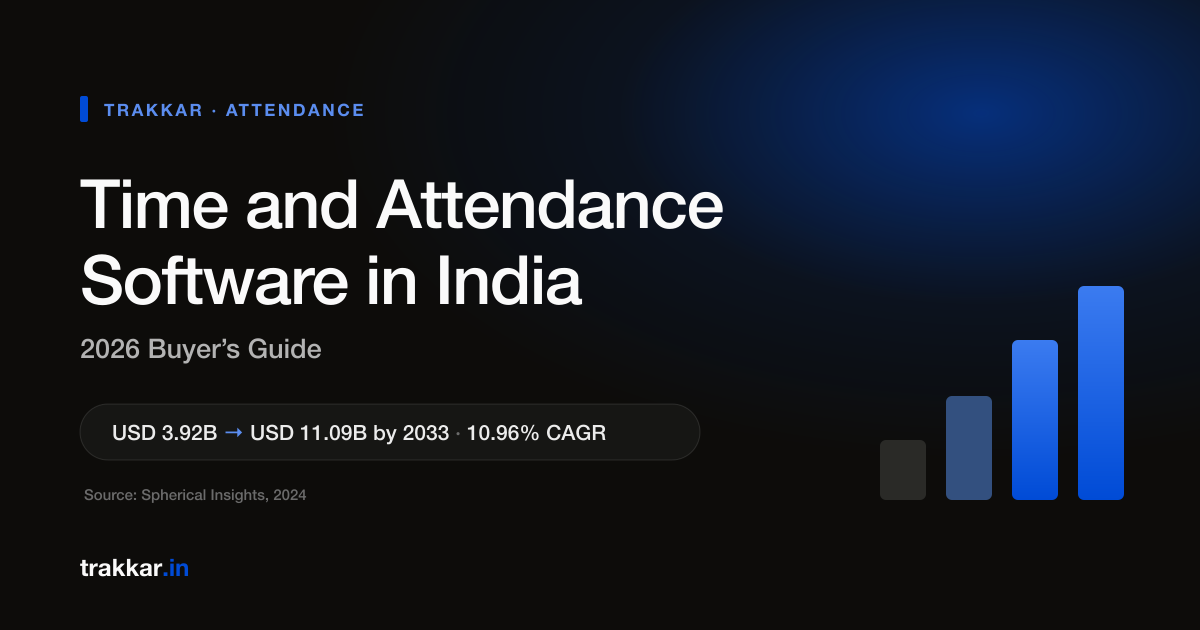
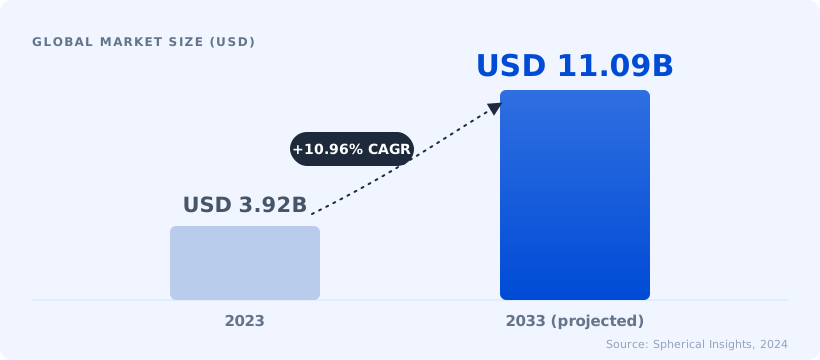
Between 2023 and 2033, the global time and attendance software category is projected to grow from USD 3.92 billion to USD 11.09 billion, a compound annual growth rate of 10.96%, according to Spherical Insights (2024). That is not a rounding error. That is serious capital betting that more teams, in more industries, will pay to know when work starts and stops.
You are not an analyst, so here is what the number means for you. Attendance software has moved from a wall-mounted punch clock to a category the whole workforce-tech industry is investing in. And the fastest growth is not where you might expect. It is in Asia-Pacific, with China and India named directly.
If you run an Indian SMB or an agency, that detail matters more than the headline. The report is describing your market becoming the centre of gravity. This guide turns the market data into a buyer's checklist for choosing time and attendance software in India: what the growth signals, where hardware still earns its place, where a mobile app quietly wins, and what to look for before you sign anything.
What is time and attendance software, and how does it work?
Spherical Insights defines it plainly: software that optimizes team productivity and labor costs by accurately tracking when employees start and stop work. You will also see it called an attendance management system or employee attendance software.
In practice, it replaces the register and the standalone punch machine with one live record. Your team marks the start and end of a shift, whether through a mobile app, a web login, a biometric reader, or a proximity card, and the system timestamps it. Presence, absence, half-days, and leave all land in the same place. From there, the same data feeds payroll, statutory records, and, for agencies, client billing.
People often confuse two things here, so it is worth separating them.
Attendance management answers "who was present, and for how long." Clock-in and clock-out, shifts, leave, week-offs. Attendance management is the system of record for presence.
Time tracking answers "where did those hours go." Which project, which task, which client. Time tracking is the system of record for effort.
A retailer may only need the first. An agency billing by the hour needs both, tied together, or the invoice never matches the timesheet. The better tools do not make you choose. They record presence and effort in one flow.
How big is the market, and how fast is it growing?
Back to the numbers. According to Spherical Insights (2024), the market was worth USD 3.92 billion in 2023 and is projected to reach USD 11.09 billion by 2033 at a 10.96% CAGR. On the component side, software holds the largest share, ahead of services. By application, retail takes the largest revenue share, with other tracked segments spanning BFSI, manufacturing, hospitals, construction, commercial and government offices, and others.
The report is just as clear about why. Three forces are pushing the category:
Demand for productivity and labour-cost tracking. Every business wants to know what its largest expense, people's time, is actually buying.
Rising adoption of HRM automation. Manual attendance and payroll reconciliation is being retired across the board.
Emerging technology. Biometrics, AI and machine learning, IoT, and geofencing are moving attendance from a paper exercise to a data one, and the whole category is moving to the cloud.
Two things hold buyers back, and both should shape your shortlist: rising data-security concerns and the high installation cost of some systems. Hold those two in mind. They map directly onto decisions an Indian SMB has to make.
A market growing at nearly 11% a year is not rewarding fancier punch clocks. It is rewarding accurate, cloud-based records that turn hours into decisions.
Why Asia-Pacific and India are the fastest-growing markets
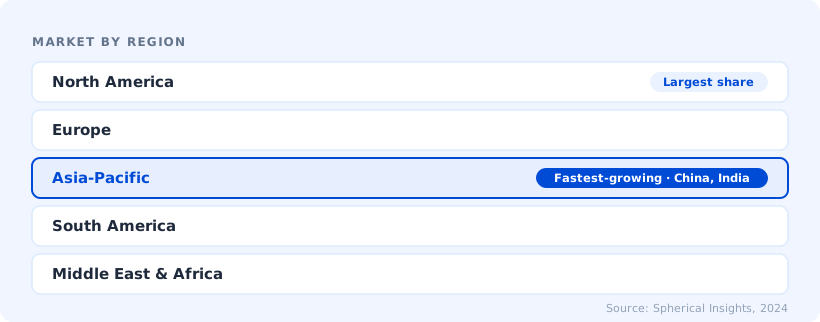
North America still holds the largest share of the market, according to Spherical Insights (2024). But Asia-Pacific is projected to grow at the fastest rate over the forecast period, with China and India called out as emerging markets and healthcare-services demand rising across the region.
That growth has an obvious cause on the ground here. India runs a large, geographically distributed workforce, and many teams across IT and ITeS, agencies, retail, manufacturing, BPO, and field services work rotating, multi-shift, or night-shift schedules. Hybrid and remote work expanded significantly after 2020, so a single SMB now often manages in-office, work-from-home, and on-the-road staff at once.
The tools have not always kept up. Paper registers, spreadsheets, and standalone biometric logs are still common, reconciled by hand at month-end. That manual burden is exactly what the market is growing to replace.
There is also a compliance layer that makes accurate attendance non-optional. Working hours and overtime for most non-factory workplaces are governed by state-specific Shops and Establishments Acts. There is no single nationwide version. Each state administers its own, so a company operating across states can face different rules in each. Statutory contributions such as Provident Fund (EPF, generally once you cross 20 employees) and Employees' State Insurance (ESI, generally once you cross 10) apply above defined thresholds, and those thresholds and wage ceilings are set by statute and revised from time to time. Your attendance and worked-hours data feed all of it.
In India, that record does more than sit in an HR folder. Payroll is calculated from it, your PF and ESI filings depend on it, and for agencies billing by the hour, so does the client invoice. Get the hours or leave wrong, and all three carry the error.
Cloud or on-premise? Biometrics or a mobile GPS app?
The report's product-type breakdown is a useful signal. Proximity cards are the fastest-growing product type, biometrics are another named segment, and cloud-based options are increasingly the norm.
Here is how to read that as a buyer rather than a vendor.
If your team clocks in at one fixed location (a store, a plant, a single office with a turnstile), a biometric attendance system or a proximity card still earns its place. Shared devices, no personal phones on the floor, a clear entry point.
If your team is distributed, hybrid, or in the field, hardware becomes a liability. You cannot bolt a fingerprint reader to a client site or a delivery route. This is where a mobile app with GPS and geofencing does the job a card never could: staff clock in from an approved location, and you get a location-stamped record without buying a single device.
Do not default to hardware because it feels rigorous. For most agencies, startups, and distributed SMBs, the honest answer is to skip biometric hardware entirely and use a cloud attendance app with GPS and geofencing. Lower cost, nothing to maintain, and it covers the people who are never in the same room.
Now the concern the report flagged: data security. This is not abstract in India. Biometric data is personal data, and it is widely treated as sensitive. Once you collect and store fingerprint or face templates, you take on obligations under India's data-protection regime, including the Digital Personal Data Protection Act, 2023 (consent and reasonable security safeguards). That is one reason many lean teams prefer app-based check-in over holding a vault of biometric templates. Whatever you choose, treat the security question as a selection criterion, not an afterthought, and confirm the specifics with your own counsel.
What to look for in time and attendance software in India
Translate all of the above into a shortlist. When you evaluate time and attendance software in India, walk through this framework before you open any pricing page.
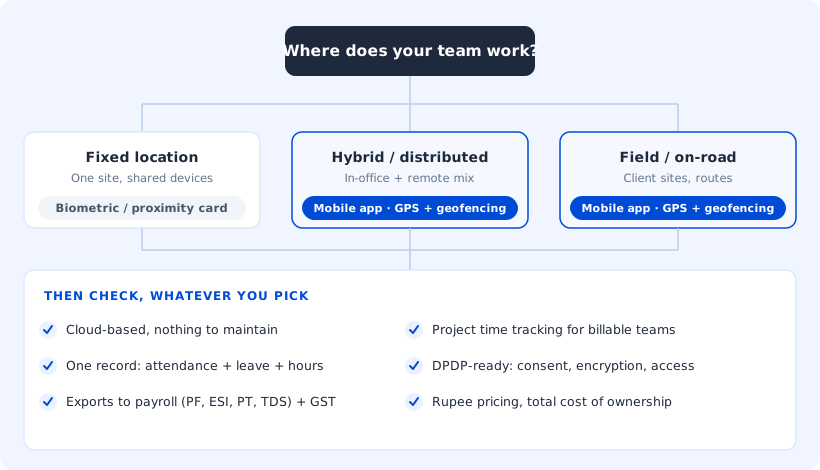
Start with where your team works. Fixed location leans toward biometric or proximity. Distributed, hybrid, or field leans toward a mobile app with GPS and geofencing. Mixed teams need both, in one system.
Insist on cloud-based. The whole market is moving there for a reason: no server to maintain, updates handled for you, and access from wherever your team actually is.
Demand one record for presence and effort. Attendance, leave, and worked hours should live together. If leave sits in a spreadsheet and hours sit in a punch log, you are back to manual reconciliation.
Check that data exports cleanly to payroll and compliance. Your attendance and hours should feed PF, ESI, PT, and TDS calculations and GST-ready invoicing without re-keying. The software does not have to run payroll itself, but its records must be trustworthy enough to base payroll on.
For billable teams, tie attendance to project time tracking. Agencies and project-based teams live or die on utilisation. Presence without project context tells you nothing about margin. Reports and analytics that show hours by project and person, with clean export to Excel, are where attendance data starts paying for itself.
Weigh total cost, not just the sticker price. A per-user rupee price is only part of it. Implementation, training, support, and any hardware all add up. The named global leaders (ADP, Oracle, SAP, UKG, Workday, Paychex, Ceridian) are built for large enterprises, with the installation cost and complexity to match. A lean Indian SMB rarely needs that weight.
How much does attendance software cost per employee in India?
There is no single right number, and anyone quoting one without knowing your team is guessing. What you can control is how you compare.
Cloud-native tools are typically priced per user per month, in rupees, with little to no upfront cost. Hardware-based systems add capital expense for readers and installation, plus maintenance, the "high installation cost" the report names. When you compare quotes, normalise them to total cost of ownership over a year: subscription, setup, training, support, and hardware combined.
For most small businesses and agencies, the best time and attendance software in India is usually a light, cloud-native, India-priced tool rather than an enterprise HR suite. You get the attendance accuracy the market is paying for, without the enterprise implementation project. You can see how that looks on Trakkar's pricing and the full feature list.
How Trakkar fits
Trakkar was built for exactly the buyer this market data describes: an Indian SMB or agency that needs accurate records without an enterprise rollout.
Attendance management records clock-in and clock-out as it happens, with leave tracking in the same place, so presence and time off live in one record instead of three. Time tracking captures where the hours actually went, and reports and analytics turn that into hours by project and person, ready to export to Excel. For project-based teams, project management ties attendance and hours to the work being delivered, so utilisation is something you can see rather than guess. Where you need an extra layer of clarity, screenshots give the team and its clients one shared, agreed record of how the workday was spent. And because billing matters here, invoicing is GST-ready and pricing is in rupees.
To make it concrete, picture a 12-person Bengaluru design agency. Half the team is in the studio, a few are permanently remote, and two account managers are usually at client sites. A fixed biometric reader would only ever capture the studio group. With a cloud app, everyone clocks in from where they are, the field staff get a location-stamped check-in, and by month-end the leave and hours data is already reconciled instead of rebuilt from memory. When a client questions an invoice, the agency points to the record instead of an estimate. That is an illustration, not a case study, but it is the shape of the problem this software solves.
Book a 20-minute demo
The market data makes the trend clear: accurate, cloud-based attendance is where workforce tooling is heading, and Asia-Pacific and India are leading the growth. The practical question is which tool fits how your team actually works.
If you are choosing between a biometric setup, a spreadsheet you have outgrown, and a cloud app built for distributed Indian teams, the fastest way to decide is to see one run against your own workflow. Book a 20-minute demo and we will walk through your team's attendance, leave, and project-hours setup, and show you exactly where the manual reconciliation goes away.